
Niacinamide With Vitamin C: How to Layer for Best Results
- Norman Church
- Aug 16
- 12 min read


Yes, you can use niacinamide with vitamin C, and for most skin, you should. These two ingredients hit hyperpigmentation and dullness from opposite directions, and using them together tends to outperform either one alone.
The practical rule is simple: apply products thinnest to thickest. If both are serums, put vitamin C on first, especially if it’s L-ascorbic acid, then wait about one to two minutes until the tackiness fades before layering niacinamide on top. If your skin flushes or stings easily, split the routine instead: vitamin C in the morning, niacinamide at night. Neither approach is wrong. It comes down to what your skin tolerates.
Layer in one session: vitamin C serum, wait a minute or two, then niacinamide serum, then moisturizer.
Sensitive skin: vitamin C in the AM under sunscreen, niacinamide in the PM with your night cream.
One-step option: a pre-formulated serum combining stabilized vitamin C with niacinamide skips the sequencing question entirely.
Pro Tip: If you’re new to vitamin C, start with a stabilized derivative like sodium ascorbyl phosphate rather than straight L-ascorbic acid. It’s gentler on first use and still works well alongside niacinamide.
A 2002 clinical study on topical niacinamide found it reduced melanosome transfer by 35 to 68 percent in human skin, which is the mechanism behind its brightening effect and one reason pairing it with vitamin C makes biological sense rather than just marketing sense.
Key Takeaways
Niacinamide and vitamin C work at different stages of pigment formation, and using them together, either layered or split by time of day, produces more complete results than using either alone.
Point | Details |
The verdict | Niacinamide and vitamin C are safe and effective when used together; the incompatibility myth is outdated lab science. |
Layering order | Apply thinnest to thickest; vitamin C first if both are serums, then wait one to two minutes. |
Sensitive skin option | Split the routine: vitamin C in the AM, niacinamide in the PM, if layering irritates your skin. |
Patch test first | Test new products for 24 to 72 hours on your inner forearm before full use. |
Sunscreen is mandatory | Daily SPF protects the pigment improvements both ingredients work to create. |
Zenith’s product lineup | Essencezenith’s Vitamin C Serum and Niacinamide Gel Moisturiser with Ceramides are built to fit directly into this exact AM/PM routine. |
This article is general information, not a substitute for advice from a qualified doctor. Consult a qualified healthcare professional about your own circumstances before acting on anything here.
Table of Contents
What Niacinamide and Vitamin C Actually Do for Your Skin
Vitamin C and niacinamide are often pitched as rivals, a “which one should I pick” decision. That framing misses the point. Dermatology writers who cover this regularly note that the comparison itself misframes the relationship: the two ingredients work at different stages of pigment production, so combining them addresses more of the problem than either one covers on its own.

Vitamin C is an antioxidant first. It neutralizes free radical damage from UV exposure and pollution, and it inhibits tyrosinase, the enzyme that kicks off melanin production upstream. It also supports collagen synthesis, which is why dermatology sources recommend applying it in the morning under sunscreen, where it adds a layer of daytime defense that SPF alone doesn’t provide.
Niacinamide, a form of vitamin B3, works downstream. Instead of blocking pigment production, it interrupts the transfer of melanosomes (the little packets of pigment) from melanocytes to skin cells. That’s the mechanism behind the 35 to 68 percent transfer reduction mentioned above. Niacinamide also strengthens the skin barrier, calms inflammation, and helps regulate oil production, which makes it useful for acne-prone and rosacea-adjacent skin types that can’t tolerate stronger actives.
Factor | Vitamin C | Niacinamide |
Primary mechanism | Inhibits tyrosinase (upstream) | Blocks melanosome transfer (downstream) |
Time to visible effect | Weeks, often faster for brightness | Slower, but broader barrier benefits |
pH sensitivity | High for L-ascorbic acid (needs low pH) | Stable across a wide pH range |
Typical use case | Daytime antioxidant, pigment, collagen | Barrier repair, oil control, all-day use |
Vitamin C fades existing pigment production at the source.
Niacinamide limits how much of that pigment actually reaches the surface.
Together, they cover both ends of the pigmentation process instead of just one.
Is the Niacinamide and Vitamin C Incompatibility Myth True?
No. The idea that niacinamide “cancels out” vitamin C traces back to lab experiments from the 1960s, not to anything that happens in a bottle on your bathroom shelf. Researchers heated raw, unbuffered niacinamide and ascorbic acid together at high temperatures and got a byproduct called nicotinic acid, along with some flushing when it was tested on skin. That reaction needed heat and pure, unformulated powders. It has nothing to do with a finished serum sitting at room temperature.
Modern formulators know this, which is exactly why so many serums, moisturizers, and combined treatments now list both ingredients on the same label. Reviews of the original incompatibility claim point out that the conditions producing nicotinic acid simply don’t exist in a properly buffered, room-temperature cosmetic product.
Modern dermatology guidance is consistent on this point: the “can’t mix” warning is a decades-old lab artifact, not a real concern for people applying finished skincare products at home. Combining niacinamide and vitamin C is described as safe and, for many skin concerns, more effective than using either ingredient alone.
That said, a small number of people with very reactive skin do report a brief flush or tingling when using high-strength L-ascorbic acid layered directly under niacinamide. That’s usually the acid doing its job, not a chemical war between ingredients. If it happens to you:
Split the routine into AM vitamin C and PM niacinamide instead of layering both at once.
Give the first product a full minute or two to absorb before applying the second.
Drop to a lower vitamin C concentration and build up slowly.
How Do You Layer Niacinamide and Vitamin C?
The governing rule for any skincare stack is texture, not chemistry: apply from thinnest to thickest so each product actually penetrates instead of sitting on top of an oil or cream barrier. That thinnest-to-thickest principle applies whether you’re mixing two serums or building a five-step routine.
Cleanse and pat skin dry.
Apply vitamin C serum first if you’re using L-ascorbic acid, since its low pH needs direct contact with skin to work properly.
Wait one to two minutes, or until the tackiness disappears.
Apply your niacinamide serum or niacinamide-containing moisturizer.
Finish with a richer moisturizer if your skin needs extra hydration.
In the morning, always finish with sunscreen.
If you have sensitive or reactive skin, you have three reasonable paths:
Split by time of day. Vitamin C in the morning under SPF, niacinamide at night with your regular moisturizer.
Use a combined formula. A stable, pre-mixed serum removes the guesswork around sequencing.
Build tolerance gradually. Start with vitamin C two or three times a week while using niacinamide daily, then increase frequency as your skin adjusts.
Pro Tip: Thicker vitamin C formulations, like creams or oil-based versions, can go under a niacinamide moisturizer without a wait time. The one-to-two-minute rule really only matters when both products are lightweight, fast-absorbing serums.
Can Niacinamide and Vitamin C Be in the Same Product?
Yes, and a lot of modern formulas do exactly that. Brands now routinely combine niacinamide with stabilized vitamin C derivatives, ingredients like ascorbyl tetraisopalmitate or magnesium ascorbyl phosphate (MAP), which are far less reactive and less irritating than pure L-ascorbic acid. Because niacinamide is chemically forgiving across a wide pH range, formulators can build a stable single product around it without the pH conflicts that plague raw ascorbic acid formulas.
Combined serums genuinely simplify a routine, and one review of niacinamide-vitamin-C pairings notes they’re a popular choice precisely because they cut a two-step process down to one.
The trade-off is control. A combined product locks you into whatever ratio and concentration the brand chose. If you have a specific concern, say, stubborn post-inflammatory marks that need a stronger vitamin C dose, or oily skin that needs more niacinamide than a blended formula provides, separate products let you dose and time each ingredient independently.
Choose a combined serum if you want simplicity and lower irritation risk.
Choose separate products if you need to push one ingredient’s concentration higher than the other.
Either path is legitimate. The decision is about control versus convenience, not safety.
What Concentrations of Niacinamide and Vitamin C Should You Use?
Vitamin C ranges more widely: L-ascorbic acid is commonly formulated at 5% to 20%, while gentler derivatives like MAP or ascorbyl glucoside are often used at similar percentages but behave more mildly on skin because they convert to active vitamin C gradually.
If you’re sensitive or new to either ingredient, start at the lower end of these ranges rather than reaching for the strongest bottle on the shelf.
Packaging matters more than most people realize. L-ascorbic acid oxidizes when exposed to air and light, turning a serum orange or brown and rendering it far less effective. Look for opaque, airtight, or pump-dispensed packaging rather than a clear jar you dip fingers into daily. Formulas that pair vitamin C with supporting antioxidants like vitamin E and ferulic acid hold their potency longer because those co-antioxidants help stabilize the vitamin C molecule itself.
Check the ingredient list for the exact form: “ascorbic acid” is the strongest and least stable; anything ending in “phosphate,” “glucoside,” or “tetraisopalmitate” is a gentler derivative.
A very low pH (often under 3.5) is a hallmark of pure L-ascorbic acid formulas.
Discoloration, a shift toward orange or brown, is a reliable sign the vitamin C has oxidized and lost strength.
How Do You Patch-Test Niacinamide and Vitamin C Safely?
Before adding either ingredient to your full routine, test it on a small patch of skin, ideally the inner forearm or just behind the ear.
Apply a small amount of the new product to clean skin.
Leave it undisturbed for 24 to 72 hours without washing that spot.
Check for redness, stinging, swelling, or discoloration at the site.
If your skin looks and feels normal, introduce the product into your routine at a low frequency.
If irritation appears, wash it off, wait for skin to calm, and try a lower concentration or a gentler derivative next time.
Some reactions are common and mild: a light tingle from an acidic vitamin C serum, or slight warmth on first use. That’s typically the acid doing its job on the skin’s surface, not a red flag. True contact dermatitis, marked by persistent redness, itching, or swelling, is rarer but worth stopping for immediately.
Practical guidance for sensitive skin often recommends using vitamin C only once or twice a week at first while keeping niacinamide as a daily step, since niacinamide is the more universally tolerated of the two.
Anyone with rosacea, eczema, or a compromised skin barrier should talk to a dermatologist before adding either active, especially at higher concentrations.
If irritation persists past a week of low-frequency use, stop and reassess rather than pushing through it.
Splitting AM and PM use is always a safe fallback if layering both at once continues to bother your skin.
How Long Until You See Results From Niacinamide and Vitamin C?
Patience matters more than people expect. Vitamin C’s brightening effects, less dullness, some fading of surface pigment, tend to show up around four to six weeks of consistent use, since it works at the pigment-production stage and its antioxidant effects build gradually.
Niacinamide runs slower on the pigmentation front. Because it works by blocking melanosome transfer rather than stopping pigment production outright, visible evenness in tone typically takes six to ten weeks or longer, though barrier improvements like reduced redness and better hydration often show up sooner than that.
Used together, most people see a more complete improvement than either ingredient delivers solo, since you’re tackling both the production and transfer stages of pigmentation at once. Reviews on photodamage and topical antioxidants consistently point out that consistent daily use paired with sunscreen is what actually protects those gains over time. Skipping SPF undoes progress fast, since new UV exposure just restarts the pigment cycle you’re trying to calm down.
Take a baseline photo in consistent lighting before you start.
Photograph weekly under the same light and angle.
Track product use in a note or app so you know exactly how long you’ve been consistent.
Sample AM and PM Routines With Niacinamide and Vitamin C
Here’s a routine you can copy directly, with room to adjust for sensitivity.
Morning routine:
Cleanser.
Vitamin C serum, applied to dry skin.
Wait one to two minutes.
Lightweight moisturizer.
Broad-spectrum sunscreen, non-negotiable.
Evening routine:
Cleanser (double cleanse if wearing sunscreen or makeup).
Niacinamide serum or a niacinamide gel moisturizer with ceramides to combine hydration and barrier repair in one step.
Eye cream, if using one, applied before heavier creams.
Richer night moisturizer to lock in hydration overnight.
For sensitive or acne-prone skin, adjust by using vitamin C two to three times a week instead of daily at first, keeping niacinamide as your daily constant, and introducing retinoids (if you use them) only on nights you skip vitamin C to avoid stacking too many actives at once.
Vitamin C serum: morning use, under sunscreen, for antioxidant defense and brightening.
Niacinamide gel moisturizer: evening use, layered over a treatment serum for barrier support.
A dedicated night cream built around ceramides helps repair the barrier while niacinamide works overnight.
An eye-area gel with caffeine can address puffiness without disrupting the rest of your actives.
Sunscreen is the one step that makes the other five worth doing. Treating pigmentation without daily SPF is like repainting a wall that’s still getting rained on. For a full walkthrough of pairing these actives with a broader pigmentation plan, see this hyperpigmentation routine breakdown.
What Does the Evidence Actually Say?
The strongest piece of evidence behind niacinamide’s brightening claim is the 2002 Hakozaki study, which measured a 35 to 68 percent reduction in melanosome transfer with topical niacinamide in human subjects. That’s not a marketing number. It’s a measured biological effect, and it’s the reason niacinamide gets recommended for pigmentation at all rather than just for oil control.
Source | Finding | What it supports |
Hakozaki et al. (2002) | 35 to 68% reduction in melanosome transfer | Niacinamide’s downstream brightening mechanism |
No meaningful incompatibility in finished products | Safety of combined daily use | |
Upstream vs. downstream pigment pathways | Rationale for pairing the two actives |
A single 2025 trial comparing a combined niacinamide and stabilized vitamin C serum against 4% hydroquinone found comparable pigment reduction with better tolerability for the combined serum. That’s a promising signal, not a settled fact. It’s one trial, and single studies deserve a healthy amount of caution before anyone treats them as the final word.
Dermatologist-authored comparisons consistently frame niacinamide and vitamin C as complementary rather than competing, pointing out that each addresses a different point in the pigmentation pathway and that using both tends to outperform using just one.
My Take: Stop Treating This Like a Rivalry
The internet loves a versus. Niacinamide vs. vitamin C gets framed like a boxing match, but that framing has never made sense to me once you actually look at what each ingredient does. One blocks pigment production at the source. The other stops the pigment that does form from reaching the surface. Pitting them against each other is like debating whether you should turn off a faucet or unclog the drain when your sink is overflowing. Do both.
What actually trips people up isn’t the ingredients. It’s impatience and packaging. Someone buys an oxidized, orange-tinted vitamin C serum because it was on sale, uses it for a week, sees nothing, and blames the ingredient instead of the bottle. Or they layer two serums, feel a slight tingle once, and decide the internet warnings about incompatibility must be true after all, when what they actually felt was just acid doing acid things.
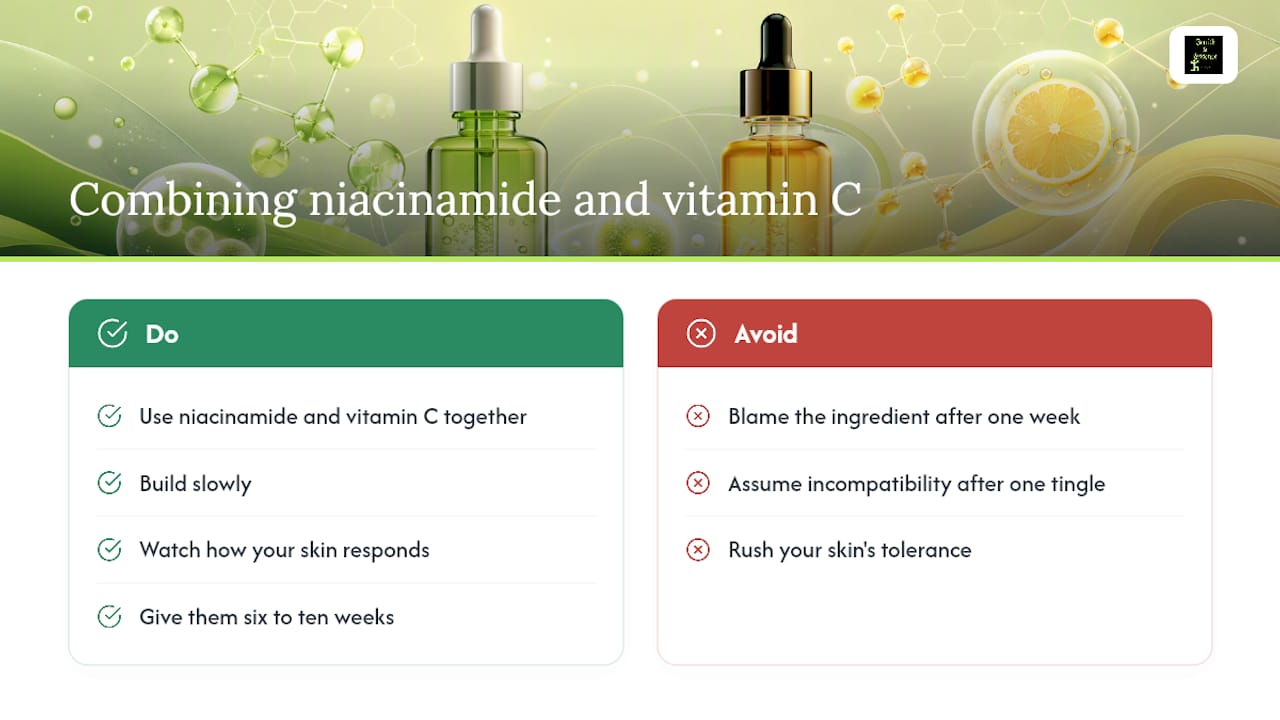
If you take one thing from this article, take this: the chemistry supports combining niacinamide and vitamin C, the dermatology literature supports it, and the only real risk is rushing your own skin’s tolerance. Build slowly, watch how your skin responds, and give it the six to ten weeks these ingredients actually need before judging whether they’re working.
If you want a second opinion on your specific skin concerns, reach out through Zenith’s contact page. Every product we recommend backs a 30-day satisfaction guarantee, so testing a new routine doesn’t have to feel like a gamble.
Where to Find Niacinamide and Vitamin C That Actually Works
If everything above has you ready to build (or rebuild) your routine, Essencezenith carries a small, curated lineup that covers exactly the steps this article walked through, without pushing you into a ten-product regimen you’ll abandon in three weeks.

Start with the Vitamin C Serum for your morning step. It’s formulated for daytime antioxidant defense and pairs cleanly with sunscreen. For evenings, the Niacinamide Gel Moisturiser with Ceramides combines barrier repair with the melanosome-blocking benefits covered earlier in one lightweight gel. Follow it with the Ceramide Hydrating Night Cream to lock in moisture while you sleep, and add the Vegan Caffeine Eye Booster Gel if puffiness or under-eye dullness is part of your concern.
Every Zenith order ships fast, and our shipping policy lays out exact timelines so there’s no guessing when your routine will arrive. If a product isn’t right for your skin, our 30-day satisfaction guarantee covers unused returns, no complicated conditions attached. Browse the current lineup and build your routine around what your skin actually needs this month.
Sources
FAQ
Can you use niacinamide and vitamin C together?
Yes. They target pigmentation at different stages, tyrosinase inhibition versus melanosome transfer, and combining them is considered safe and often more effective than using just one.
What should you not mix with niacinamide?
Niacinamide is broadly compatible with most actives, including vitamin C, but pairing it with very high concentrations of strong acids or retinoids without building tolerance first can increase irritation risk for sensitive skin.
What should you not mix with vitamin C?
Avoid layering vitamin C directly with strong exfoliating acids or benzoyl peroxide at the same time, since the combined acidity can increase irritation; space them into different parts of your routine or different days instead.
Can I use niacinamide at night and vitamin C in the morning?
Yes, this is one of the most commonly recommended approaches, especially for sensitive skin, since it pairs vitamin C’s daytime antioxidant role with niacinamide’s barrier repair benefits overnight.
How long does it take to see results from niacinamide and vitamin C?
Vitamin C’s brightening effects often appear in four to six weeks, while niacinamide’s pigmentation benefits typically take six to ten weeks or longer, since it works through a slower, transfer-blocking mechanism.
Recommended
Comments