
What Does Formaldehyde-Free Mean in Beauty?

TL;DR:
Formaldehyde-free beauty products contain no added formaldehyde or preservatives that release it. This label indicates a reduction in exposure but does not guarantee complete absence of formaldehyde, as trace amounts are naturally present. Reading ingredient labels and understanding industry terms helps consumers identify safer options and reduce allergy risks effectively.
Formaldehyde-free in beauty means a product contains no added formaldehyde and no preservatives that release formaldehyde as they break down. The term addresses a real health concern: allergic contact dermatitis is the primary risk for most consumers, not cancer. Regulatory bodies like the EU and the North American Contact Dermatitis Group (NACDG) have shaped how brands label and formulate products around this ingredient. Understanding what the claim actually covers, and where it falls short, puts you in a far stronger position when choosing safe beauty products without formaldehyde.
What does formaldehyde-free mean in beauty products?
Formaldehyde-free is a labeling claim, not a regulated standard with a universal legal definition. It signals that a brand has intentionally excluded formaldehyde and the class of ingredients known as formaldehyde-releasing preservatives from its formula. The industry term for these preservatives is “formaldehyde releasers,” and they are far more common in cosmetics than pure formaldehyde itself.
Most beauty products contain formaldehyde releasers rather than formaldehyde listed directly on the label. That distinction matters because releasers slowly emit small amounts of formaldehyde over time to prevent bacterial growth. A product can legally omit “formaldehyde” from its ingredient list while still containing DMDM hydantoin or quaternium-15, both of which release it.
The formaldehyde-free meaning also carries an important nuance: trace formaldehyde exists naturally in the human body and in the environment. Health experts describe formaldehyde-free claims as a reduction strategy rather than an absolute guarantee of zero exposure. Choosing formaldehyde-free cosmetics meaningfully lowers your added exposure, but it does not eliminate every possible source.
What is formaldehyde and why is it used in beauty products?
Formaldehyde is a colorless gas with a sharp odor. In cosmetics, it functions primarily as a preservative, killing bacteria and extending shelf life at low cost. Brands historically favored it because it works across a wide pH range and remains stable in many formula types.
The ingredient shows up in several product categories:
Shampoos and conditioners use formaldehyde releasers to prevent microbial contamination in water-based formulas.
Nail hardeners sometimes contain direct formaldehyde at low concentrations to cross-link keratin proteins.
Hair smoothing treatments are the highest-risk category, because heat activates chemical reactions that release formaldehyde gas.
Liquid soaps and body washes often rely on releasers like imidazolidinyl urea for broad-spectrum preservation.
Mascara and eyeliner may contain releasers to prevent mold growth near the eye area.
The distinction between direct formaldehyde and formaldehyde-releasing preservatives is critical for reading labels accurately. Direct formaldehyde appears rarely. Releasers appear constantly, under chemical names most shoppers do not recognize. Learning those names is the most practical step toward identifying quality beauty ingredients before you buy.
What are the health risks and allergy concerns?

The NACDG data makes the allergy picture concrete. 7.7% of patients tested by the NACDG were allergic to formaldehyde, and 2% reacted specifically to DMDM hydantoin. Those numbers reflect clinical patch testing, meaning real people with real reactions to ingredients found in everyday products.
Allergic contact dermatitis from formaldehyde typically appears as redness, itching, and swelling at the site of contact. Repeated exposure can worsen sensitivity over time, a process called sensitization. Once sensitized, even small amounts of a releaser can trigger a reaction.
The cancer question is more nuanced than headlines suggest. Occupational inhalation at high concentrations, not routine cosmetic use, drives the cancer risk data. The greater everyday concern is sensitization and chronic skin irritation from releasers in rinse-off and leave-on products.
The hair treatment category carries the sharpest warning. Women who used chemical hair straighteners more than four times per year had more than double the uterine cancer risk in an NIH study. That finding points to frequent, high-dose exposure rather than occasional use of a standard shampoo.
Many salon treatments marketed as formaldehyde-free contain methylene glycol, a liquid form that converts back to formaldehyde gas when heated. Stylists and clients inhale that gas in enclosed spaces. The “formaldehyde-free” label on those products is technically accurate at room temperature and genuinely misleading in practice.
How do regulations and labeling affect formaldehyde in beauty products?
Regulatory standards for formaldehyde vary sharply between regions, and 2026 brought a significant change in Europe.
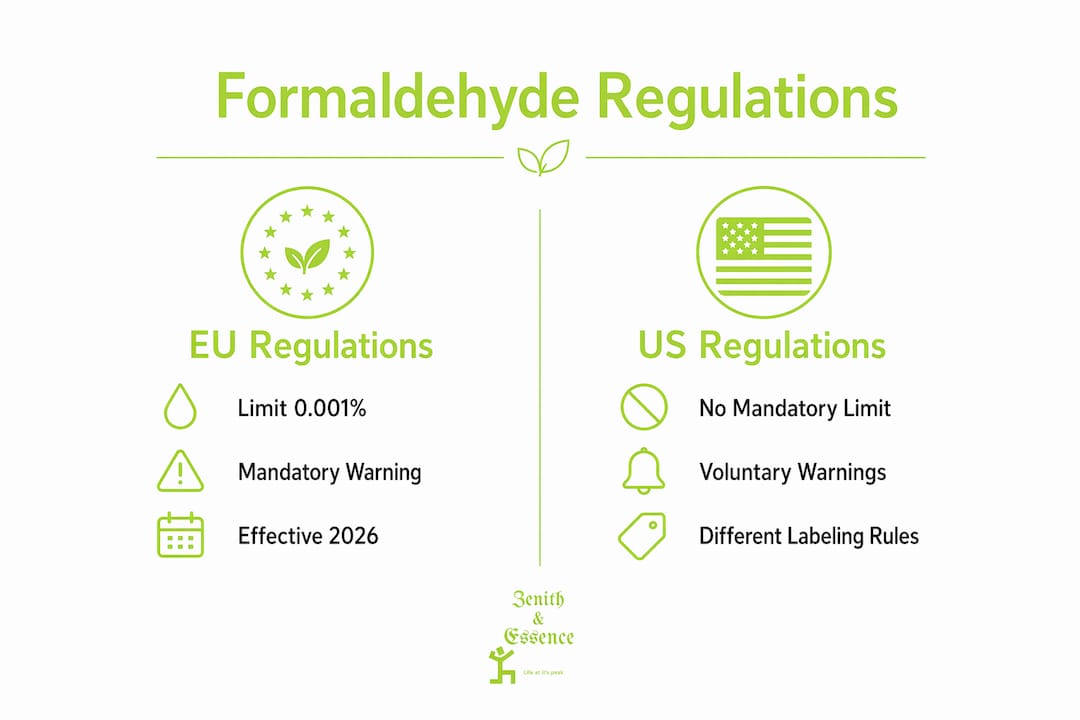
Region | Formaldehyde limit | Label requirement |
EU (from 2026) | 0.001% (10 ppm) | “Releases formaldehyde” warning required above threshold |
EU (pre-2026) | 0.05% | Warning required above threshold |
United States | No federal ban; low concentrations permitted | No mandatory warning label |
The EU lowered its mandatory warning threshold from 0.05% to 0.001% in 2026. That is a 50-fold reduction in the trigger point for a label warning. The change reflects growing evidence that lower concentrations still cause sensitization in susceptible individuals.
The US market operates under different rules. The FDA does not require a “releases formaldehyde” warning, and several releasers banned or restricted in the EU remain permitted at low concentrations in American products. Regulatory differences mean that the same brand may sell different formulas in Europe and the United States. A product cleared for EU shelves under the new rules meets a stricter standard than its American equivalent.
Pro Tip: When shopping American brands, check whether the product also carries EU certification or complies with EU Annex standards. That compliance signals a stricter formulation, even without a US-mandated warning label.
Understanding the 2026 consumer protection updates in beauty regulation helps you interpret labels accurately across markets.
What does formaldehyde-free actually mean for your health?
The benefits of formaldehyde-free products are real, but the claim requires careful interpretation. No cosmetic product exists in a formaldehyde-free vacuum. The human body produces formaldehyde naturally during metabolism. Indoor formaldehyde off-gassing from furniture and building materials often exceeds outdoor air levels, adding to total daily exposure for sensitive individuals.
Switching to formaldehyde-free skincare and hair products reduces your controllable exposure. That reduction is meaningful, especially for anyone already sensitized or managing eczema-prone skin. The practical steps for making that switch are straightforward:
Learn the releaser names. DMDM hydantoin, quaternium-15, imidazolidinyl urea, diazolidinyl urea, and bronopol are the most common. None of them say “formaldehyde” on the label.
Prioritize leave-on products. Rinse-off products like shampoo have lower contact time. Moisturizers, serums, and foundations stay on skin for hours, increasing absorption risk.
Ventilate during heat styling. If you use any heat-activated smoothing treatment, open windows and run ventilation. This applies even to products labeled formaldehyde-free.
Check nail products separately. Nail hardeners follow different formulation logic than skincare. Some still use direct formaldehyde at concentrations that exceed what most people realize.
Look for named alternatives. The industry shift toward safer preservatives includes phenoxyethanol, potassium sorbate, and benzoic acid. Seeing these on a label is a positive sign.
Pro Tip: The “5-free” or “10-free” labels on nail products refer to a list of excluded ingredients, and formaldehyde is typically the first item on that list. These labels offer a quick shortcut for formaldehyde-free nail care.
Understanding non-toxic beauty claims alongside formaldehyde-free ones gives you a fuller picture of what a product actually avoids.
How to identify and choose truly formaldehyde-free beauty products
Reading ingredient labels is the single most reliable method for identifying formaldehyde content. Brands are not required to advertise releasers prominently, but they must list every ingredient. Knowing what to look for closes that gap.
Scan for releaser names first. DMDM hydantoin and quaternium-15 appear most frequently in rinse-off products. Imidazolidinyl urea and diazolidinyl urea appear more often in leave-on formulas.
Check for the EU “releases formaldehyde” warning. Products sold in Europe above the 0.001% threshold must carry this label. Its absence on an EU-compliant product is a meaningful signal.
Use “5-free” or “10-free” nail labels as a filter. These marketing terms have become a reliable shorthand in the nail category, where formaldehyde use is most direct.
Patch test if you are sensitive. Apply a small amount to your inner arm and wait 48 hours before full use. This step matters most for leave-on products like moisturizers and serums.
Prioritize brand transparency. Brands that publish full ingredient lists, explain their preservative choices, and respond to ingredient questions are more likely to maintain consistent formulation standards.
The beauty purchase protection checklist covers additional steps for verifying ingredient safety before committing to a product.
Key Takeaways
Formaldehyde-free beauty products reduce your exposure to a known allergen and sensitizer, but the claim only holds up when you know how to read labels for hidden releasers.
Point | Details |
Formaldehyde-free meaning | The claim excludes added formaldehyde and formaldehyde-releasing preservatives, not all trace formaldehyde. |
Primary health risk | Allergic contact dermatitis from releasers is the most common concern, affecting 7.7% of clinically tested patients. |
2026 EU regulation | The EU now requires a warning label at 0.001%, a 50-fold stricter threshold than the previous standard. |
Hidden releasers | DMDM hydantoin, quaternium-15, and imidazolidinyl urea are the names to scan for on ingredient lists. |
Safer alternatives | Phenoxyethanol, potassium sorbate, and benzoic acid are the leading formaldehyde-free preservative replacements. |
What I’ve learned from years of watching the clean beauty conversation
The formaldehyde debate in beauty has always suffered from two extremes. One side dismisses the concern entirely, pointing to low concentrations and natural body production. The other treats any trace as a crisis. Neither position serves you well.
What I have observed is that the real risk is cumulative and individual. A person with no sensitization history can use a releaser-containing shampoo for years without issue. Someone already sensitized to formaldehyde can react to a moisturizer containing imidazolidinyl urea within hours. The NACDG’s 7.7% allergy figure is not a small number when you consider how many people use multiple products daily.
The 2026 EU threshold change is the most significant regulatory signal in years. A 50-fold reduction in the warning trigger is not a minor adjustment. It reflects a genuine reassessment of what “safe” means at the population level, particularly for people who layer multiple products.
My practical advice: do not wait for a reaction to start reading labels. Ingredient literacy is the most durable protection you have, and it costs nothing. The brands worth trusting are the ones that make that literacy easy, not the ones that hide behind proprietary blends and vague “clean” claims.
— Norman
Formaldehyde-free beauty at Essencezenith
Knowing what to avoid is only half the work. Finding products that actually meet that standard is where most shoppers lose time.
Essencezenith curates a clean beauty collection built around ingredient transparency and health-conscious formulation. Every product in the sustainable living essentials category is selected with preservative safety in mind, so you are not left decoding ingredient lists on your own. Essencezenith also backs every purchase with a 30-day satisfaction guarantee, which means you can try a formaldehyde-free alternative without risk. If you have questions about specific ingredients or product suitability, the team is available to help you choose with confidence.
FAQ
What does formaldehyde-free mean on a beauty label?
Formaldehyde-free means the product contains no added formaldehyde and no preservatives that release formaldehyde during use. The claim is a reduction strategy, not a guarantee of zero formaldehyde, since trace amounts exist naturally in the environment and the human body.
What are the most common formaldehyde releasers in cosmetics?
DMDM hydantoin, quaternium-15, imidazolidinyl urea, diazolidinyl urea, and bronopol are the most frequently used formaldehyde-releasing preservatives. None of them list “formaldehyde” by name on ingredient labels.
Are formaldehyde-free hair products actually safer?
Yes, with one important exception. Standard formaldehyde-free shampoos and conditioners meaningfully reduce allergen exposure. However, some heat-activated smoothing treatments labeled formaldehyde-free contain methylene glycol, which releases formaldehyde gas when heated, posing an inhalation risk.
How do EU and US regulations on formaldehyde differ?
The EU now requires a “releases formaldehyde” warning label when concentration exceeds 0.001%, following the 2026 regulatory update. The US has no equivalent mandatory warning, and several releasers restricted in the EU remain permitted in American products at low concentrations.
Who is most at risk from formaldehyde in beauty products?
People with existing formaldehyde sensitization, eczema-prone skin, or frequent exposure through professional salon treatments carry the highest risk. Clinical data from the NACDG shows 7.7% of tested patients are allergic to formaldehyde, making it one of the more prevalent contact allergens in cosmetics.
Recommended
Comments