
What Does a B-Corp Beauty Brand Mean for You?
- Norman Church
- 3 days ago
- 8 min read


A B-Corp beauty brand is a company certified by B Lab to meet verified standards for social and environmental performance, transparency, and accountability, making it one of the most credible ethical markers in the beauty industry today. Unlike a product label such as “cruelty-free” or “organic,” B-Corp certification evaluates the entire company, from how it treats workers to how it manages its environmental footprint. Brands like Aveda, The Body Shop, and Kjaer Weis have pursued this certification precisely because it signals something product labels cannot: a whole-business commitment to doing less harm and more good. If you have ever wondered whether a beauty brand’s sustainability claims are real or just clever marketing, understanding B-Corp certification is the clearest place to start.
What does a B-Corp beauty brand mean in practice?
B Lab defines Certified B Corporations through the B Impact Assessment, a rigorous scoring framework that examines a company across multiple impact areas simultaneously. The assessment covers five core categories: governance, workers, community, environment, and customers. A company must score a minimum of 80 out of 200 points to qualify, and every claim is subject to independent verification, not self-reporting.
This matters for beauty consumers because the certification does not just ask whether a brand uses recycled packaging. It asks whether the company’s leadership is legally accountable for social and environmental decisions, whether workers receive fair wages, and whether supplier relationships reflect ethical sourcing standards. The scope is far broader than any single product claim.
The B Impact Assessment also requires companies to embed stakeholder consideration into their governance structure. Stakeholder governance means the board and leadership must weigh the interests of workers, communities, and the environment in business decisions, not just shareholder returns. For a beauty brand, this could translate into commitments like sourcing fair-trade botanicals, maintaining transparent supply chains, or capping executive pay ratios.

Pro Tip: Visit the B Lab directory at bcorporation.net to look up any brand’s actual B Impact Assessment score and see exactly which areas they performed strongest in before you buy.
Key standards B-Corp beauty brands must meet include:
Governance: Legal accountability for social and environmental performance baked into company structure
Workers: Fair wages, benefits, and safe working conditions throughout the supply chain
Community: Ethical sourcing, charitable giving, and positive local economic impact
Environment: Measured reduction in carbon footprint, water use, and waste generation
Customers: Transparent marketing, product safety standards, and data privacy practices
How B-Corp certification differs from other ethical beauty claims
Most sustainability labels in beauty operate at the product level. A “certified organic” label tells you about ingredient sourcing for that specific formula. A “cruelty-free” certification tells you no animal testing occurred for that product. These are meaningful, but they say nothing about how the company pays its factory workers or whether its carbon emissions are growing year over year.
B-Corp certification reduces unsupported sustainability claims by requiring evidence-based verification of business practices across the whole organization. A brand cannot simply declare itself sustainable and earn the B Corp mark. It must submit documentation, undergo third-party auditing, and meet a quantified threshold. This is the structural difference between a certification and a marketing claim.
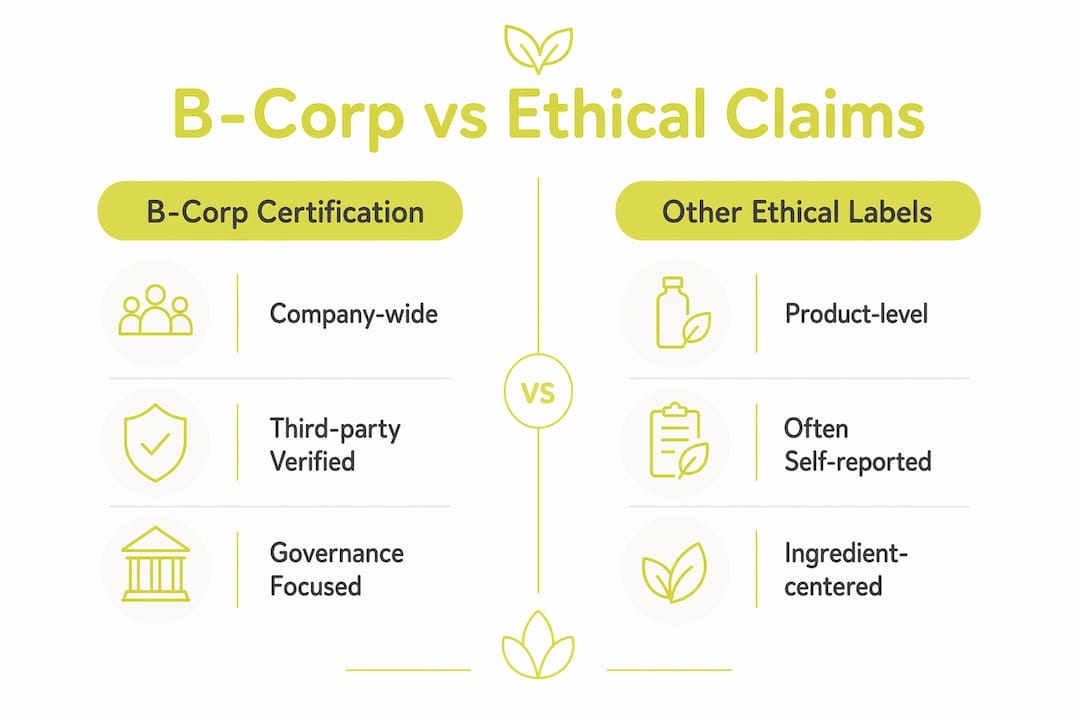
Certification type | Scope | Verified by third party? | Covers company practices? |
B-Corp | Whole company | Yes | Yes |
Certified Organic | Specific ingredients | Yes | No |
Cruelty-Free (Leaping Bunny) | Animal testing policy | Yes | Partially |
Brand self-declaration | Varies | No | No |
Ethical marketing standards are now embedded in B Lab’s Purpose and Stakeholder Governance requirements, meaning B Corp brands are held accountable for how they communicate sustainability claims to consumers. A brand cannot earn or keep its certification while running misleading green marketing campaigns. This is a direct structural defense against greenwashing.
One important limitation: B-Corp certification does not guarantee that specific product ingredients are safe, biodegradable, or free from controversial chemicals. A certified company could still sell a product containing synthetic fragrance or silicones. Consumers who care about ingredient safety should layer B-Corp status with product-level certifications like EWG Verified or COSMOS Organic.
Pro Tip: Think of B-Corp as the company’s report card and ingredient certifications as the product’s report card. You want both to score well before committing to a brand.
Why buying from a B-Corp beauty brand actually matters
Choosing a B-Corp certified beauty brand is a direct vote for a business model that treats profit as a means, not the only end. B Corp certification signals commitment to responsible business practices that benefit people and the planet, giving consumers a credible benchmark that most beauty marketing simply cannot match.
The practical benefits of supporting these brands extend well beyond the product in your hands:
Worker protection: B-Corp standards require fair labor practices, meaning the people making your moisturizer or serum are more likely to earn living wages and work in safe conditions.
Environmental accountability: Certified brands must measure and report environmental performance, creating real pressure to reduce emissions, water use, and packaging waste over time.
Supply chain transparency: Community impact criteria push brands to source ingredients ethically, which matters enormously in an industry that relies heavily on plant-based materials from vulnerable ecosystems.
Anti-greenwashing protection: Because public B Corp profiles detail actual impact scores, you can compare brands on real data rather than marketing copy.
Ongoing improvement: Unlike a one-time award, B-Corp status requires brands to keep improving. A brand that coasts on its initial score risks losing certification at recertification.
The broader effect is also worth noting. When B-Corp beauty brands grow market share, they create competitive pressure on uncertified brands to raise their own standards. Your purchasing decision contributes to that shift.
How to identify and evaluate B-Corp beauty brands
Knowing a brand carries the B Corp logo is a starting point, not a finish line. Here is how to go deeper and make genuinely informed choices:
Search the official B Lab directory. Go to bcorporation.net and search any brand by name. The directory shows current certification status, overall score, and a breakdown by impact category. A score of 80 qualifies; scores above 100 indicate exceptional performance.
Check recertification status. Recertification cycles are mandatory every three to five years, and older certifications may not reflect current practices. If a brand’s last certification date is more than five years ago, treat that as a yellow flag and look for updated information.
Review the impact area breakdown. A brand might score high on governance but low on environment. Knowing where a brand excels and where it falls short helps you decide whether its strengths align with your personal priorities.
Layer in product-level certifications. Check whether the specific products you are buying carry certifications like COSMOS Organic, Leaping Bunny, or EWG Verified. B-Corp status covers the company; these labels cover the formula. For a deeper look at sustainable skincare standards, understanding both levels of certification makes you a far more confident shopper.
Read the brand’s public impact report. Many B-Corp brands publish annual impact reports that go beyond the B Lab assessment. These documents often reveal specific commitments, progress metrics, and honest acknowledgment of areas still needing work. Brands that publish these reports openly are demonstrating exactly the kind of transparency the certification is designed to reward.
Key takeaways
B-Corp certification is the most credible company-level ethical benchmark available to beauty consumers because it combines independent verification, quantified scoring, and mandatory recertification into a single standard.
Point | Details |
Company-level certification | B-Corp evaluates the whole business, not individual products or ingredients. |
Independent verification | Third-party auditing by B Lab distinguishes it from brand self-declarations. |
Recertification required | Brands must recertify every 3 to 5 years, so always check that status is current. |
Does not cover ingredients | Layer B-Corp status with product certifications like COSMOS Organic or EWG Verified. |
Public profiles available | Use the B Lab directory to compare brands on actual impact scores before buying. |
Why I think most consumers underuse B-Corp data
Most shoppers see the B Corp logo and treat it as a binary: either a brand has it or it does not. That is leaving a lot of information on the table. The B Impact Assessment produces a detailed numerical score across five categories, and two brands can both be certified while performing very differently on the dimensions you actually care about.
I have spent years reviewing sustainability claims across the beauty sector, and the pattern I see repeatedly is this: brands lean heavily on their certification status in marketing while burying the actual score. A brand that barely cleared 80 points and a brand that scored 140 are both “B-Corp certified,” but they are not equivalent ethical choices. The directory makes this comparison easy, and almost nobody uses it.
The other misconception I encounter constantly is the assumption that B-Corp certification means a product is safe or clean in the ingredient sense. It does not. I have seen certified brands sell products with ingredient profiles that would concern a careful formulation reader. B-Corp tells you the company is run with integrity. It does not tell you the formula is free from synthetic preservatives or hormone-disrupting fragrance compounds. Use both lenses.
The brands I find most trustworthy are those that score well on B-Corp, publish detailed impact reports, AND carry product-level certifications on their formulas. That combination is rare, but it exists. When you find it, you have found a brand worth your loyalty and your money.
— Norman
Discover ethical beauty brands at Essencezenith
Essencezenith curates beauty products with the same commitment to transparency that B-Corp certification demands. Every product in the Essencezenith catalog is selected for ingredient quality, sustainable sourcing, and proven efficacy, so you are never guessing about what you are putting on your skin. Shoppers who care about ethical beauty can explore certified organic options alongside a full range of products that meet rigorous sustainability standards. With a 30-day satisfaction guarantee and fast shipping, Essencezenith removes the risk from ethical beauty shopping entirely. Browse the full sustainable beauty collection and find brands that back their claims with real certification.
FAQ
What does B-Corp mean for a beauty brand?
A B-Corp beauty brand is a company certified by B Lab to meet verified standards for social and environmental performance, governance, transparency, and accountability at the company level. The certification is awarded after independent third-party assessment using the B Impact Assessment scoring framework.
Does B-Corp certification cover product ingredients?
No. B-Corp certification is company-level and does not certify that specific product ingredients are safe, organic, or biodegradable. Consumers should check product-level certifications like COSMOS Organic or EWG Verified for ingredient-specific assurances.
How often do B-Corp beauty brands need to recertify?
Recertification is mandatory every three to five years, and brands must demonstrate ongoing improvement to maintain their status. Always verify that a brand’s certification is current by checking the official B Lab directory.
How is B-Corp different from cruelty-free or organic labels?
B-Corp evaluates the entire company across governance, workers, community, environment, and customers. Cruelty-free and organic labels apply to specific products or practices. B-Corp offers independent verification of whole-business ethics, while product labels address narrower claims.
Where can I verify a beauty brand’s B-Corp status?
Search the official B Lab directory at bcorporation.net to confirm current certification status, view the overall impact score, and review performance by category. This public data lets you compare certified brands on actual metrics rather than marketing language.
Recommended
Comments