
How to Compare Beauty Retailers Online: 2026 Guide


Comparing beauty retailers online means evaluating product range, pricing, return policies, and customer experience side by side before you spend a dollar. The best online beauty stores are not interchangeable. Sephora, Ulta, and Dermstore each serve different shopper priorities, and choosing the wrong one costs you money, time, and the wrong shade of foundation. This guide gives you a practical framework to find beauty products online with confidence, avoid common traps, and get the most value from every purchase.
How to compare beauty retailers online: what actually matters
The criteria that separate a great online beauty retailer from a frustrating one fall into five categories. Understanding each one before you browse saves you from buyer’s remorse.
Product selection is the starting point. Prestige retailers like Sephora carry luxury brands such as Charlotte Tilbury and Fenty Beauty, while Ulta stocks prestige and drugstore brands side by side, giving you e.l.f. and ColourPop alongside higher-end lines. If you exclusively shop luxury, a prestige-focused retailer is the right fit. If you mix budget and splurge, a hybrid retailer saves you shipping costs.
Pricing and sales cycles matter more than most shoppers realize. The same NARS concealer can vary by $5 to $10 across retailers depending on the week. Free shipping thresholds typically start at $35 to $50, so a $30 order that triggers a shipping fee at one retailer may ship free at another.

Return policies are where shoppers get burned most often. A careful review of return policies prevents unpleasant surprises, especially around receipt requirements and restrictions on opened products. Without a receipt, returns often default to store credit at the lowest selling price, not the price you paid.
Loyalty programs add real value beyond a simple points balance. Early sale access, birthday gifts, and personalized recommendations are built into tiered programs at major retailers. These perks reward frequent shoppers significantly more than casual buyers.
Shipping speed and customer service close the gap between online and in-store shopping. A retailer with a 24-hour response window and clear tracking beats one with a wider catalog but slow support.
Product selection: prestige only vs. prestige plus drugstore
Pricing: base price, sale frequency, and shipping minimums
Return policy: window length, receipt requirements, opened product rules
Loyalty program: points value, tier benefits, early access perks
Shipping: speed, cost, and minimum order thresholds
Pro Tip: Before adding anything to your cart, open the retailer’s return policy page in a separate tab. Confirm whether the item category is returnable and whether you need the original receipt. This 60-second check prevents the most common online beauty shopping regret.
Sephora vs. Ulta: which retailer wins for your needs?
The Sephora vs. Ulta debate is the most common comparison shoppers run, and the answer depends entirely on what you prioritize.
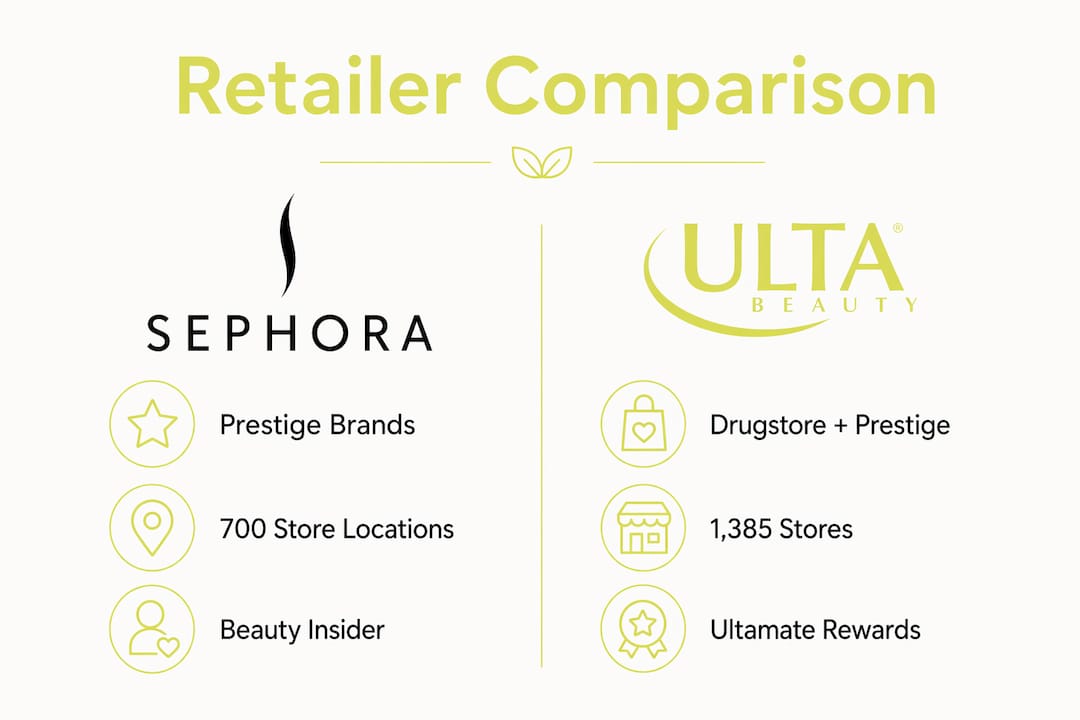
Sephora operates roughly 700 U.S. locations and focuses almost entirely on prestige and luxury brands. Its Beauty Insider program offers three tiers: Insider, VIB, and Rouge, with Rouge members unlocking the most aggressive sale pricing and early access. The online experience is polished, with virtual try-on tools and detailed brand storytelling that mirrors the in-store feel. Sephora is the right choice if brand exclusivity and a curated luxury experience are your top priorities.
Ulta runs over 1,385 U.S. stores and carries 600-plus brands spanning drugstore to prestige. Its Ultamate Rewards program earns points on every dollar spent, including on drugstore purchases, which Sephora’s program does not cover. Ulta’s 21 Days of Beauty sale offers steep discounts on prestige products, making it one of the best moments in the year to stock up. Ulta also operates in-store salons, which adds a service layer no pure beauty retailer matches.
Feature | Sephora | Ulta |
Brand focus | Prestige and luxury only | Prestige plus drugstore |
U.S. store count | ~700 | ~1,385 |
Loyalty program | Beauty Insider (3 tiers) | Ultamate Rewards (points-based) |
Signature sale | Beauty Insider Sale | 21 Days of Beauty |
Return window | 60 days | 60 days |
Salon services | No | Yes |
Both retailers share a 60-day return window for online orders and accept gently used products under certain conditions. The difference is in the details: Sephora’s online return process is tightly integrated with its app, while Ulta allows in-store returns for online purchases at any location, which is more convenient for shoppers near a store.
Pro Tip: If you shop both retailers, time your Sephora purchases around the Beauty Insider Sale and your Ulta purchases around 21 Days of Beauty. Stacking these two events across the year cuts your annual beauty spend significantly without sacrificing the brands you love.
Loyalty program tiers are designed to reward higher spenders with multiplier bonuses and exclusive event access. If you spend $1,000 or more annually on beauty, reaching Sephora’s Rouge tier or Ulta’s Diamond tier unlocks benefits that easily offset the cost of staying loyal to one platform.
Which other online beauty retailers are worth comparing?
Sephora and Ulta dominate the conversation, but three other categories of retailers deserve serious consideration depending on your skin concerns and shopping habits.
Dermstore specializes in clinical-grade skincare and dermatologist-backed products, making it the strongest option for shoppers treating specific skin concerns like hyperpigmentation, rosacea, or acne. Its catalog skips mass-market makeup entirely and focuses on brands like SkinCeuticals, PCA Skin, and EltaMD. If your priority is efficacy over aesthetics, Dermstore fills a gap that Sephora and Ulta do not.
Nordstrom and Macy’s offer department store beauty shopping with wide brand selections, strong rewards programs, and customer-friendly return policies. Nordstrom in particular is known for accepting returns without friction, which makes it a low-risk option for trying new brands. Both retailers run major annual sales, with Nordstrom’s Anniversary Sale offering some of the deepest discounts on prestige beauty of the year.
Specialty and clean beauty retailers fill a third niche. Sites focused on ingredient transparency and sustainable sourcing attract shoppers who read labels before they buy. These retailers often carry brands not available at mainstream stores, and their editorial curation helps you discover products matched to your values, not just your skin type.
Here is a quick breakdown of how these retailers compare on key factors:
Retailer | Specialty | Best for |
Dermstore | Clinical skincare | Targeted skin concerns |
Nordstrom | Wide selection, easy returns | Brand variety and low-risk shopping |
Macy’s | Department store breadth | Variety and rewards stacking |
Clean beauty specialists | Ingredient transparency | Conscious beauty shoppers |
Check whether the retailer is an authorized seller of the brands it carries. Gray-market beauty products are a real problem online.
Read recent customer reviews, not just the star rating. Look for patterns in complaints about shipping damage or product authenticity.
Confirm whether the retailer ships to your location and what the delivery window looks like before committing.
You can also elevate your beauty routine by mixing products from different retailers strategically, pairing a clinical serum from Dermstore with a prestige foundation from Sephora and a drugstore mascara from Ulta.
Practical steps for comparing beauty retailers effectively
A structured approach to retailer comparison takes less than 10 minutes and prevents the most common shopping mistakes. Follow these steps before you commit to a purchase.
Identify the specific product you want and search for it across at least three retailers simultaneously. Price differences on the same SKU are more common than most shoppers expect.
Check the shipping cost at your cart total. A retailer with a $5 lower product price but a $7 shipping fee is not actually cheaper. Factor in the free shipping threshold before comparing totals.
Read the return policy for that specific product category. Some retailers exclude skincare, opened cosmetics, or sale items from standard return windows. Confirm before you buy.
Calculate your loyalty program value. If you already have points at one retailer, factor in what those points are worth against the price difference at a competitor.
Use price tracking tools to check whether the item is at its normal price or inflated ahead of a sale. Price tracking apps help shoppers avoid buying during price inflations and time purchases around events like Ulta’s 21 Days of Beauty.
Set restock alerts for sold-out items rather than buying a substitute you are less confident about. Most major retailers offer email or app notifications for restocks.
Both Sephora and Ulta invest in virtual try-on technology and detailed customer reviews to reduce the uncertainty of buying makeup online. Use these tools before purchasing any foundation, concealer, or lip color. They are not perfect, but they cut return rates significantly.
Pro Tip: Screenshot the return policy page at the time of purchase. Retailers update policies periodically, and having a timestamped record protects you if a dispute arises later.
Common mistakes shoppers make when comparing beauty retailers
Even experienced shoppers fall into predictable traps when they compare makeup prices and retailer policies online.
Ignoring return policy nuances. A 60-day return window sounds generous until you realize the item you bought is a final sale exclusion or requires the original packaging you already discarded.
Treating loyalty points as free money. Points expire, redemption minimums apply, and some categories earn at a lower rate. Know the rules before you factor points into your comparison.
Forgetting to include shipping costs. A $2 price advantage disappears instantly if one retailer charges $6.99 for shipping on your order size.
Skipping brand authenticity checks. Third-party sellers on marketplace-style platforms sometimes list counterfeit or expired beauty products. Stick to authorized retailers for skincare and treatment products especially.
Buying impulsively outside planned sale windows. Major retailers run predictable sale cycles. Buying a prestige moisturizer two weeks before a known sale event costs you 20% or more with no benefit.
Key takeaways
Choosing the right beauty retailer online requires comparing product range, pricing, return policies, and loyalty value together, not any single factor in isolation.
Point | Details |
Product range drives fit | Match the retailer to your brand priorities: prestige only, mixed, or clinical skincare. |
Return policies have hidden rules | Confirm receipt requirements and opened product restrictions before every purchase. |
Loyalty programs reward strategy | Time purchases around tier-specific sales to extract maximum value from points. |
Shipping costs change the math | Always calculate total cost including shipping before comparing prices across retailers. |
Price tracking prevents overpaying | Use tracking tools to buy at historical lows and align purchases with known sale events. |
What I’ve learned from years of watching shoppers get this wrong
The single most underrated factor in any beauty retailer comparison is the return experience, not the return policy. Every major retailer publishes a generous-sounding policy. The real test is what happens when you actually need to use it. I have seen shoppers choose a retailer based on a $3 price difference, only to spend 45 minutes on hold trying to process a return because the item arrived damaged. That $3 saving cost them an hour and a lot of frustration.
My honest advice: weight the return experience as heavily as the price. Read recent one-star reviews specifically for mentions of return problems. If a pattern shows up across multiple reviewers in the last 90 days, that is a live signal, not an outlier.
The second thing most shoppers get wrong is treating loyalty programs as a reason to stay loyal rather than a tool to use strategically. Sephora’s Beauty Insider and Ulta’s Ultamate Rewards are both well-designed programs, but the value is concentrated in specific moments: sale events, birthday months, and tier upgrade windows. Shoppers who spread purchases across five retailers to “compare” end up reaching meaningful tier levels at none of them.
Pick two retailers that cover your core needs. Go deep on both loyalty programs. Then use price tracking and sale timing to decide which retailer gets each specific purchase. That approach beats both blind loyalty and constant comparison shopping. For affordable options that complement a prestige routine, the guide to affordable beauty tools is worth bookmarking.
— Norman
Why Essencezenith belongs in your retailer comparison
After you have run your comparison across Sephora, Ulta, and Dermstore, Essencezenith deserves a place on that list. Essencezenith curates premium sustainable beauty products built around powerful, clean ingredients designed to enhance your natural appearance rather than simply cover it up. Every product comes with transparent ingredient sourcing, genuine customer reviews, and a 30-day satisfaction guarantee covering unused items.

Essencezenith ships fast, keeps its interface clean and easy to navigate, and backs every purchase with real customer feedback so you know what you are buying before it arrives. If you are looking for a retailer that combines luxury quality with ingredient transparency and a no-hassle return policy, Essencezenith is built exactly for that. Explore the certified organic facial oil from BYMANYC New York as a starting point for what the curation looks like in practice.
FAQ
What is the best way to compare beauty retailers online?
Compare retailers across five factors: product selection, total price including shipping, return policy details, loyalty program value, and customer service reputation. Running this check on two or three retailers before purchasing takes under 10 minutes and prevents most common shopping mistakes.
Do Sephora and Ulta have the same return policy?
Both offer a 60-day return window for online orders and accept gently used products, but conditions vary. Without a receipt, returns at either retailer typically default to store credit at the lowest selling price rather than the original purchase price.
Is Dermstore better than Sephora for skincare?
Dermstore focuses on clinical-grade skincare from dermatologist-backed brands like SkinCeuticals and EltaMD, making it the stronger choice for targeted skin concerns. Sephora offers broader brand variety but does not specialize in clinical efficacy.
How do I find the best price on beauty products online?
Use price tracking tools to check historical pricing before you buy, and align purchases with known sale events like Ulta’s 21 Days of Beauty or Sephora’s Beauty Insider Sale. These two events alone cover most of the prestige beauty calendar.
Are discount beauty retailers trustworthy?
Discount retailers are trustworthy when they are authorized sellers of the brands they carry. Always verify authorized seller status for skincare and treatment products, where counterfeit or expired inventory poses a real risk to your skin.
Recommended
Comments