
How to Avoid Greenwashing When You Shop for Anything Green

To avoid greenwashing, favor specific, verifiable claims backed by third-party verification and disclosed data, never vague adjectives or a green leaf on the label. Check the entity behind the claim before you trust it: the FTC’s Green Guides define what terms like “recyclable” and “carbon neutral” are supposed to mean, and the United Nations has spent years cataloging how companies dodge those definitions.
Here’s your shelf-side checklist:
Look for a number, not an adjective (“30% recycled ocean plastic,” not “eco-friendly”).
Confirm a named third-party certifier, then check that certifier’s own criteria.
See if the claim discloses a baseline year and methodology.
Skip anything that leans on nature photos or green packaging instead of data.
Check whether the claim covers the whole product or just one ingredient.
These rules track closely with what Consumer Reports and NRDC both tell shoppers: specificity and independent verification beat marketing language every time.
Key Takeaways
Avoiding greenwashing comes down to one habit: demand a specific, verifiable number and a named third-party certifier before you trust any environmental claim.
Point | Details |
Specificity beats adjectives | Look for percentages, baseline years, and defined scope instead of words like “eco-friendly.” |
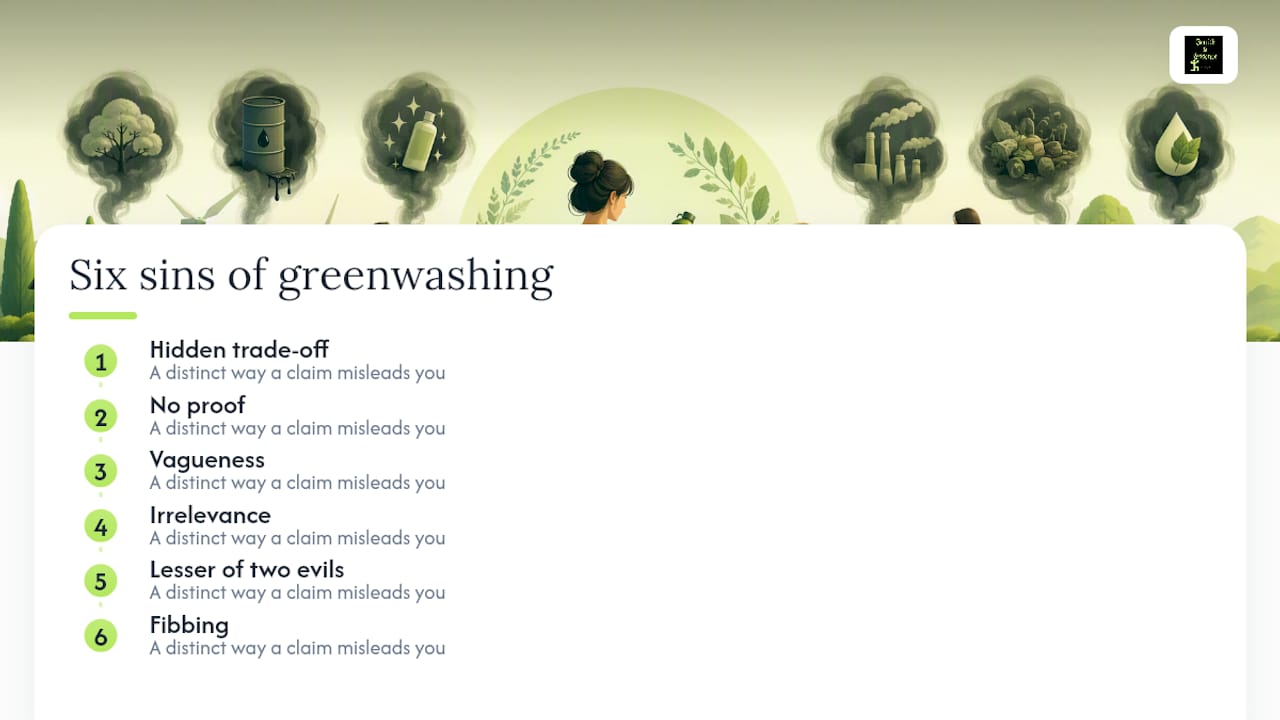
Watch for the Six Sins | Vagueness, hidden trade-offs, no proof, irrelevance, lesser-of-two-evils, and fibbing are the recurring patterns to flag. |
Verify certifications directly | Search the certifier’s own database rather than trusting the badge on the package. |
Escalate when claims don’t hold up | Save screenshots and file a complaint with the FTC if a brand won’t back up its claim. |
Essencezenith vets before listing | Products are checked for ingredient transparency, verified ecolabels, and published test data before they’re sold. |
Table of Contents
What Greenwashing Actually Means
Greenwashing is the practice of making environmental claims that are misleading, unverified, or flat-out false. It runs on a spectrum. On one end, a brand slaps “natural” on a bottle with no supporting data. On the other, a company outright fabricates a certification that doesn’t exist.
A common version sits in the middle: a fashion label launches a small “eco” capsule collection, photographs it in a forest, and lets that imagery color perception of its entire petroleum-heavy product line. The eco line is real. The impression it creates about the whole brand isn’t.
Why Greenwashing Actually Costs You
Greenwashing isn’t a harmless marketing quirk. It has real costs on three fronts.
You lose money and trust. You pay a premium for a claim that turns out to be empty, and your next purchase decision gets harder to trust.
It distorts the market. Brands doing the real work of cutting emissions or sourcing responsibly get outcompeted by brands that just talk about it.
It slows down actual climate progress. The UN frames this directly: greenwashing promotes false solutions that distract from and delay credible climate action, which means every dollar spent chasing a fake claim is a dollar not rewarding a company doing the harder, slower work of change.
The Six Sins and Other Red Flags to Watch For
Environmental marketing firm TerraChoice identified a set of recurring greenwashing patterns years ago, and they still hold up as a diagnostic tool today.
Hidden trade-off: touting one green attribute (recycled packaging) while ignoring a bigger issue (high water use in manufacturing).
No proof: a claim with zero documentation, certification, or accessible data to back it.
Vagueness: words like “eco-friendly” or “natural” that carry no regulated, checkable meaning on their own.
Irrelevance: true but meaningless claims, like “CFC-free” on a product where CFCs were already banned decades ago.
Lesser of two evils: true within a bad category, like “organic cigarettes.”
Fibbing: claims that are simply false, including fake certification logos.
Fashion is a repeat offender here. A brand might market a small “conscious” collection made from recycled fibers while much of its line still runs on virgin polyester and fast turnover, a pattern the UNEP sustainable fashion communication playbook calls out directly. Outside apparel, watch for packaging marked “100% recyclable” when the label, inner pouch, or coating actually can’t go through a standard recycling stream.
There’s a visual layer to all this too. Earth tones, leaf icons, and soft green palettes are a design choice, not evidence. Consumer Reports points out that this kind of visual greenwashing works precisely because it triggers a gut reaction before your brain checks for actual proof.

Your Step-by-Step Vetting Checklist Before You Buy
Run through this sequence before you add something to your cart:
Read the exact claim. Note the specific wording, not your general impression of the packaging.
Check for a number. A real claim has a percentage, a date, or a defined scope attached to it.
Find the benchmark. “50% less water” means nothing without knowing less than what, and measured how.
Verify the certification. Search the certifier’s name directly and confirm the product actually appears in their database.
Look at the boundary. Does the claim cover the whole company, one product line, or a single ingredient?
Check for a baseline year. Carbon neutrality and emissions claims should state their starting point and whether they rely on offsets or actual reductions.
Look for independent assurance. Sustainability reports carrying third-party audit language carry more weight than self-reported numbers.
Compare to the category norm. If every competitor makes the same claim, it may be industry standard rather than a genuine differentiator.
Pro Tip: Search the brand’s site for a dedicated certifications or sustainability page, then click straight into the certifier’s own published criteria instead of trusting the brand’s summary of it. If a brand can’t link you to a working certifier database entry, treat the claim as unverified.
Questions to Ask a Brand Before You Trust the Claim
Copy these directly into a product-page chat or customer service email:
“What standard or third-party verifier supports this specific claim?”
“What baseline year and boundary do you use for this percentage?”
“Is this reduction measured, offset, or both?”
“Can you link me to your certifier’s public criteria?”
“Does this claim cover the whole product or one component?”
“Where is your methodology published?”
A helpful answer includes a name, a link, or a document. A red-flag reply repeats the marketing copy back to you or says “we’re committed to sustainability” without specifics.
What to Do If You Suspect a Brand Is Greenwashing You
Pause the purchase and screenshot the claim, the product page URL, and the date.
Email the brand directly and ask for the evidence outlined above.
If the response is vague or absent, file a complaint with the FTC, which enforces truth-in-advertising standards under its Green Guides.
Post what you found on social media or a consumer forum. Public accountability often moves faster than a formal complaint.
Which Certifications Are Actually Worth Trusting
Not every seal on a package means the same thing, and some exist purely to look official.
FSC (Forest Stewardship Council): covers responsibly sourced wood and paper products.
USDA Organic: governs agricultural ingredients grown without prohibited synthetic inputs.
Energy Star: applies to energy efficiency in appliances and electronics.
Cradle to Cradle Certified: rates material health, circularity, and manufacturing across several categories, and keeps a public database of certified products you can search directly.
B Corp: certifies overall company social and environmental performance, not a single product attribute.
Blue Angel: a German ecolabel covering a wide range of consumer goods and their environmental impact.
Before you trust any of these, check whether the label covers the whole company or just one product, and whether it addresses the supply chain or a single attribute like packaging. Some marks are industry-created rather than independently run. If a certifier’s criteria aren’t public and searchable, NRDC recommends treating the mark with real skepticism.
Essencezenith’s Checklist for Vetting Beauty Brands
We apply a version of this same checklist to every beauty brand we curate, because “clean beauty” gets greenwashed as often as fast fashion does.
Ingredient lists are published in full, not summarized as “natural extracts.”
Ecolabels and certifications are verified against the certifier’s own database, not just the brand’s badge.
Packaging recyclability or compostability is stated with the actual material, not a generic “eco-packaging” label.
Supply chains are traceable back to sourcing, not just to a finished-goods factory.
Efficacy claims come with published test data, not just before-and-after photos.
We cover this in more depth in our guide to sustainable beauty and in our trustworthy beauty brand checklist, both built around the same specificity-first standard.
A Publisher’s Note on Why This Matters
I’ve read enough sustainability reports to know that the ones worth trusting admit where they’ve fallen short, not just where they’ve won. Our checklist exists because transparency should be checkable, not just claimed.
Shop Beauty Products Vetted for Real Transparency
Most beauty shopping still asks you to take a brand’s word for it: a green label, a soft-focus nature photo, a vague promise of “clean” ingredients with no data behind it. Essencezenith runs a different process. Every product we carry gets checked against ingredient transparency, verified certifications, and published efficacy data before it ever reaches a product page, so you’re not the one stuck digging through a certifier’s database at midnight.
That vetting is backed by a 30-day satisfaction guarantee, so if a product doesn’t perform the way its listing says it should, you can return it unused. Browse our curated natural beauty picks or head to Essencezenith to see the full catalog and shop products that already passed the questions this article just taught you to ask.
Sources
FAQ
What is a famous example of greenwashing?
Fashion brands launching a small “conscious” or “eco” capsule collection while the majority of their line remains petroleum-based synthetic materials is one of the most commonly cited patterns, according to UNEP’s sustainable fashion guidance.
What exactly does greenwashing mean?
Greenwashing means making environmental claims that are misleading, unsubstantiated, or false, ranging from vague marketing language to outright fabricated certifications.
What are the six sins of greenwashing?
The six sins identified by TerraChoice are hidden trade-off, no proof, vagueness, irrelevance, lesser of two evils, and fibbing, and each describes a distinct way a claim can mislead you.
Is it illegal to greenwash?
It can be. The FTC enforces truth-in-advertising standards through its Green Guides, and a false or unsubstantiated environmental claim can trigger regulatory action.
Recommended
Comments