
How to Verify Beauty Brand Credibility Before You Buy

TL;DR:
Verifying beauty brand credibility involves checking legal registration, ingredient transparency, and clinical evidence. Consumer feedback and manufacturing details further confirm trustworthiness, reducing the risk of counterfeit products. A structured process helps shoppers identify reliable brands and protect their skin health and investments.
Beauty brand credibility is defined as a brand’s ability to back its claims with verifiable, transparent information about ingredients, manufacturing, legal standing, and clinical evidence. Buying from an unverified brand puts your skin health and your money at risk. Counterfeit or misleading products flood the online market, and marketing language alone tells you nothing about what is actually in the bottle. This guide gives you a repeatable, structured process to assess beauty brand trustworthiness before you spend a dollar.
How to verify beauty brand credibility: what you need first
Before you evaluate any brand, gather the right tools and set realistic expectations. A thorough credibility assessment takes 15–20 minutes per brand. That time investment is worth it when you consider the alternative: wasted money and potential skin reactions.
Start with these resources:
Public business registration databases. In the United States, the Secretary of State’s business search portal works. For EU brands, look for a named Responsible Person. Korean brands should carry a 10-digit registration number from the National Tax Service.
Ingredient databases. The International Nomenclature of Cosmetic Ingredients (INCI) standard is the global naming system for cosmetic ingredients. Use it to cross-reference any ingredient list you find on a product page.
Independent review platforms. Sites like Reddit’s skincare communities, Beautypedia, and consumer protection forums give you unfiltered feedback outside the brand’s own channels.
The brand’s own website. Look specifically for a physical address, a returns policy, and a contact page with a real phone number or email.
Pro Tip: Before you spend time reading reviews, check the business registration first. If the brand has no verifiable legal identity, nothing else on the page matters.
Step-by-step process to evaluate skincare brand authenticity
A structured vetting process scores brands across 5–10 dimensions including ingredient transparency, manufacturing standards, and customer support. Brands that score below 5 out of 10 carry high risk. Work through these steps in order.
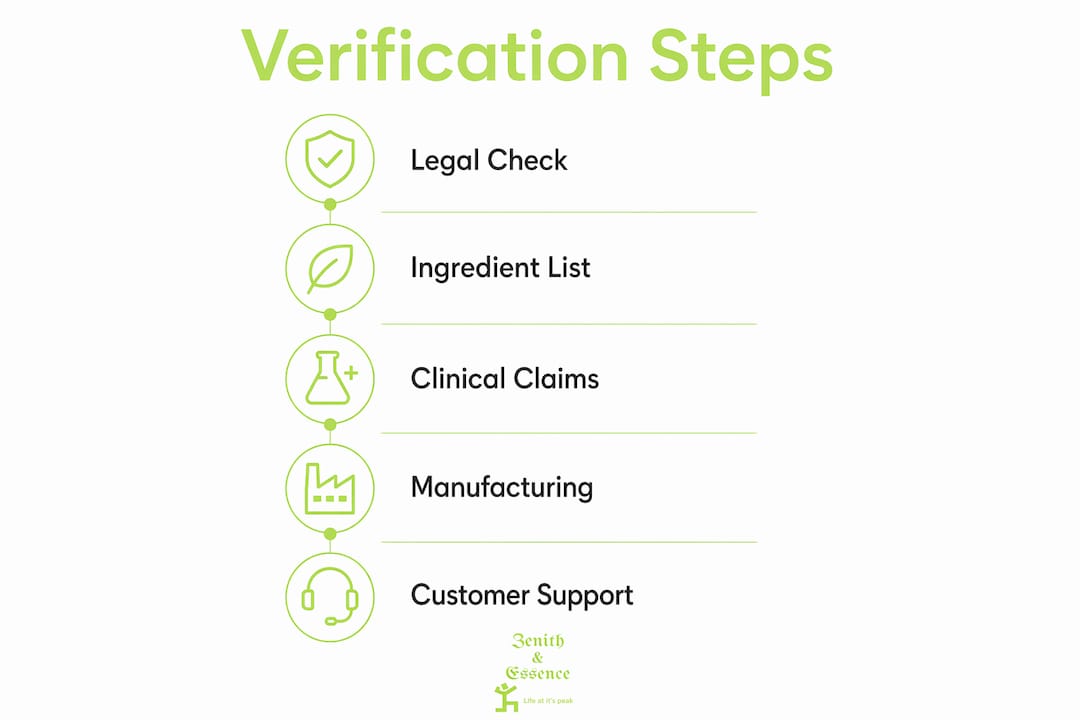
1. Confirm legal business registration
Verifying legal registration filters out over 90% of fraudulent storefronts and takes under 10 minutes. Search the brand name in your country’s public business database. A legitimate brand will have a registered entity name, a physical address, and a registration number. No registration means no accountability.

2. Check ingredient list transparency
Full INCI lists are non-negotiable for credible brands. Brands that hide behind “proprietary blends” without disclosing individual ingredients signal weak formulation ethics. Look for brands that name key actives, explain their concentrations where possible, and provide usage guidance. If the ingredient list is absent from the product page entirely, treat that as a serious warning.
3. Assess clinical claim legitimacy
A credible clinical claim specifies the study design, sample size, duration, and whether results were assessed by dermatologists or self-reported. “Clinically proven” with no methodology attached is not evidence. The gold standard is a randomized, double-blind, placebo-controlled design. Anything less requires scrutiny. For a deeper look at how study disclosures affect brand credibility, the role of clinical studies in beauty purchasing decisions is worth understanding.
4. Review manufacturing and packaging consistency
Brands open about their manufacturing partners show operational discipline. Look for mentions of contract labs, in-house facilities, or Good Manufacturing Practice (GMP) certification. Check that the packaging matches what is shown on the product page. Inconsistencies between the website photos and the actual product are a reliable red flag.
5. Test customer support accessibility
Send a pre-purchase question to the brand’s support channel. A credible brand responds within 24–48 hours with a specific, helpful answer. Vague auto-replies or no response at all signal that post-purchase complaints will go nowhere. Also check whether the brand publishes a clear returns policy and a transparent complaint resolution process.
Pro Tip: Use the signs of authentic beauty products checklist as a quick reference while you work through each step above.
Here is a quick scoring guide to use during your assessment:
Dimension | Strong signal | Weak signal |
Legal registration | Verified business entity with physical address | No registration or PO box only |
Ingredient transparency | Full INCI list with active concentrations | “Proprietary blend” with no detail |
Clinical claims | Study design, sample size, and duration disclosed | “Clinically proven” with no methodology |
Manufacturing | GMP-certified or named facility disclosed | No manufacturing information |
Customer support | Responds within 48 hours with specific answers | Auto-reply only or no response |
Common red flags when assessing beauty brand trustworthiness
The most dangerous mistake shoppers make is confusing polished marketing with verified quality. Trust is best treated as a verifiable checklist, not a feeling. These are the red flags that should immediately lower your confidence in a brand.
Vague marketing language. Terms like “natural,” “clean,” “dermatologist-approved,” and “clinically tested” carry no legal definition in the United States unless backed by specific evidence. Demand the details behind the claim.
Influencer endorsements without evidence. A celebrity partnership tells you about a brand’s marketing budget, not its product quality. Endorsements are paid placements unless explicitly disclosed otherwise.
Weak clinical claims. No sample size, no test duration, no study design. These are not clinical claims. They are advertising copy dressed up to look scientific.
Inconsistent messaging across platforms. If the brand’s Amazon listing describes the product differently than its own website, that inconsistency signals poor quality control or deliberate misdirection.
Single-source praise. One glowing review, even from a trusted publication, is not a pattern. Credibility requires consistency across multiple independent sources.
“A brand that cannot clearly answer where its products are made, what is in them, and who is legally responsible for them is not a brand you should trust with your skin or your money.”
How to use consumer feedback to validate brand reliability
Consumer feedback is the most underused verification tool available. Scanning multiple independent review sites and forums reveals consistent complaint patterns that a single review never could. Look for repeated mentions of the same issue across unrelated sources.
Focus on these specific signals:
Irritation or reaction reports. One report is anecdotal. Five reports across different forums describing the same reaction to the same product is a pattern worth taking seriously.
Shipping and fulfillment complaints. Repeated delays or wrong items signal operational problems that often reflect deeper quality control issues.
Repeat restocks and long-term customers. Shoppers who repurchase the same product over months or years are the strongest trust signal available. Repeat restocks and responsive service are positive indicators that a brand delivers on its promises.
Brand responses to negative reviews. A brand that publicly acknowledges complaints and resolves them demonstrates accountability. A brand that ignores or deletes negative feedback does not.
The key distinction is between a one-off negative review and a systemic issue. One unhappy customer proves nothing. Ten customers describing the same problem in the same words proves a lot. A repeatable vetting process that looks for patterns rather than isolated complaints is the most reliable approach.
Review signal | What it means |
Single negative review | Likely an isolated experience; low concern |
Repeated same complaint | Systemic product or service issue; high concern |
Long-term repeat buyers | Strong product efficacy signal |
Brand responds publicly | Accountability and operational maturity |
Brand deletes complaints | Transparency failure; significant red flag |
Pro Tip: Search the brand name plus “review” and “complaint” in separate searches. The complaint search often surfaces issues that the review search buries.
Key Takeaways
Verifying beauty brand credibility requires checking legal registration, ingredient transparency, clinical evidence, manufacturing disclosure, and consumer feedback patterns before you buy.
Point | Details |
Start with legal registration | A verified business entity with a physical address filters out most fraudulent brands immediately. |
Demand full ingredient lists | Full INCI disclosure signals formulation ethics; proprietary blends without detail do not. |
Scrutinize clinical claims | Credible claims name the study design, sample size, duration, and who assessed the results. |
Look for manufacturing transparency | GMP certification or a named facility shows the brand operates with discipline. |
Read review patterns, not single reviews | Repeated complaints across independent sources reveal systemic issues that one review never will. |
Why I stopped trusting my gut on beauty brands
I spent years buying beauty products based on packaging, price point, and the occasional glowing magazine feature. The results were inconsistent at best and genuinely damaging at worst. One brand I trusted for two years turned out to have no verifiable business registration and an ingredient list that changed between product batches. That experience changed how I approach every purchase.
The uncomfortable truth is that the beauty industry rewards confident marketing far more than it rewards transparency. Brands know that most shoppers will not check a business registration database or ask for a study’s sample size. The trustworthy beauty brand checklist approach works precisely because it removes gut feeling from the equation entirely. You either have the evidence or you do not.
What I have found is that genuinely credible brands are not defensive about scrutiny. They publish their manufacturing information, they respond to questions, and they do not hide behind vague language. Brands that resist transparency are almost always hiding something worth knowing. Protecting your skin health and your money requires treating verification as a habit, not a one-time check.
— Norman
Essencezenith makes verified beauty shopping straightforward
Knowing what to look for is only half the work. Finding brands that already meet those standards is where most shoppers lose time.
Essencezenith curates beauty products selected for ingredient quality, manufacturing transparency, and genuine consumer feedback. Every product on the platform reflects a commitment to showing you what is actually in it and why it works. The Essencezenith catalog pairs that curation with a 30-day satisfaction guarantee, so you can buy with confidence rather than hope. If a product does not deliver, you return it. No friction, no fine print. For shoppers who have done the research and want a platform that has already done the vetting, Essencezenith is the place to start.
FAQ
What is the fastest way to check a beauty brand’s legitimacy?
Search the brand name in your country’s public business registration database. This single step takes under 10 minutes and eliminates most fraudulent storefronts immediately.
What does “clinically proven” actually mean on a beauty product?
It means nothing without supporting details. A credible clinical claim discloses the study design, sample size, duration, and whether results were assessed by dermatologists or self-reported by participants.
How do I know if an ingredient list is trustworthy?
A trustworthy ingredient list uses full INCI names for every ingredient and does not hide key actives behind “proprietary blend” language. Brands that explain concentrations and usage guidance show higher formulation ethics.
How many reviews should I read before trusting a brand?
Read enough to identify patterns across independent sources. A single review proves nothing. Repeated praise or repeated complaints across unrelated forums and platforms are the signals worth acting on.
What is a Responsible Person in EU beauty regulations?
A Responsible Person is the legally named entity accountable for a cosmetic product’s compliance with EU regulations. Brands selling in the EU without a named Responsible Person are non-compliant and should be avoided.
Recommended
Comments