
Phthalates in Fragrance: What Tests Reveal and How to Shop

Yes, many perfumes contain diethyl phthalate, or DEP, used as a solvent that helps fragrance oils dissolve and last longer on skin. Regulators consider typical exposure from a single product low risk, but daily use of multiple scented items adds up. If you want to lower your exposure, look for products labeled phthalate-free and avoid stacking several scented leave-on items in one routine.
TL;DR:
Most perfumes contain diethyl phthalate, which helps fragrance last longer and dissolve better, but frequent use of multiple scented products increases overall exposure.
Biomonitoring studies show that routine fragrance use correlates with higher urinary levels of phthalate metabolites, especially for those repeatedly applying several products daily.
Phthalates are common in cosmetics because they improve solubility, longevity, and stability, but reformulations are increasingly using safer, alternative fixatives like citrates and natural resins.
Regulatory bodies in the US do not restrict DEP in fragrances, and ingredient labeling often lists “fragrance” without specifying phthalates, making individual assessment difficult without third-party testing.
To reduce exposure, consumers should look for verified “phthalate-free” claims, limit layering scented products, and prefer rinse-off fragrances over leave-on options whenever possible.
Table of Contents
What Phthalates Are and Which Ones Show Up in Fragrance
Phthalates are a family of industrial chemicals used to make plastics flexible and to help other ingredients dissolve or stick around longer. In fragrance, they work as solvents and fixatives, meaning they carry scent molecules and slow down how fast a perfume evaporates off your skin.
Chemists have used several phthalates in perfumery over the decades, but the lineup has narrowed considerably. DEP (diethyl phthalate) remains the one still in common use. DBP (dibutyl phthalate) and DMP (dimethyl phthalate) once showed up in older formulas, but FDA cosmetic ingredient surveys found DEP to be the only phthalate still widely used in cosmetics, with the others now rare in current products.
Why did perfumers gravitate toward DEP specifically? A few practical reasons:
Solubility. DEP dissolves fragrance oils cleanly without leaving residue or altering the scent profile.
Longevity. It slows evaporation, so a spray of perfume lasts hours instead of minutes.
Cost and availability. DEP is cheap to produce and has a long track record in cosmetic chemistry, making it an easy default for formulators.
Stability. It holds up well across a wide temperature range, which matters for products that sit on store shelves or in bathroom cabinets for months.
None of this means every bottle of perfume on the shelf contains DEP. Plenty of modern fragrances, especially from brands marketing “clean” or “phthalate-free” lines, have reformulated around alternative fixatives. But because U.S. labeling rules don’t force disclosure of every fragrance component (more on that shortly), you often can’t tell just by reading the box.
How Phthalates Get Into Your Body From Fragrance
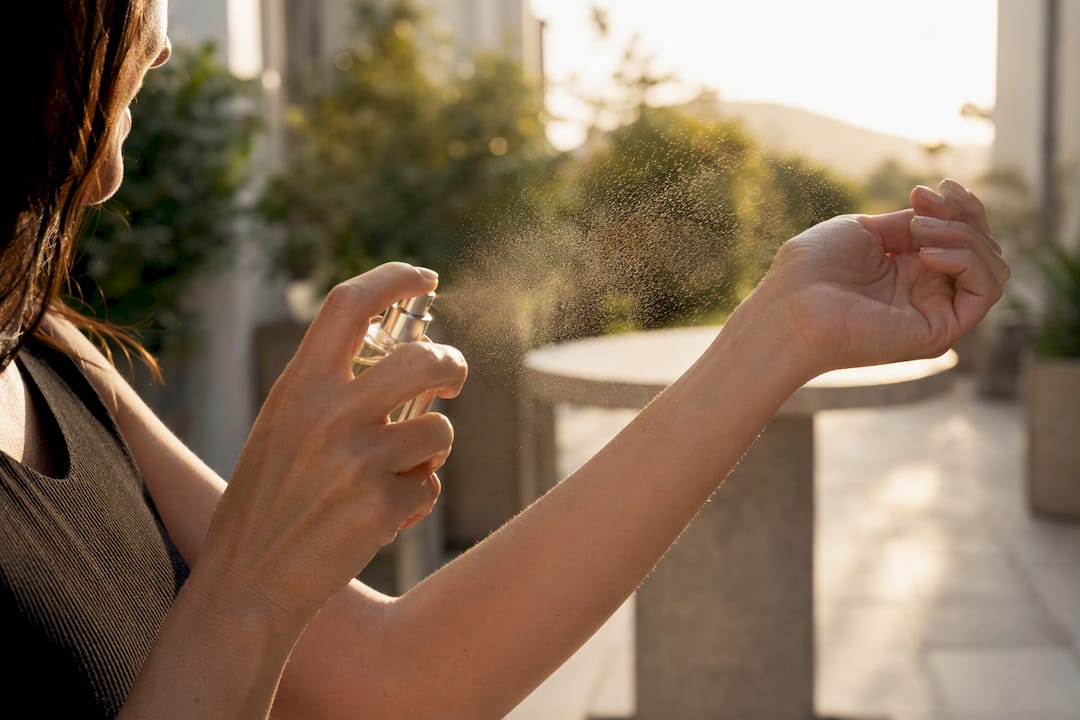
Two routes matter most: your skin and your lungs. When you spray perfume, some of it lands on skin and absorbs directly. The rest becomes airborne and you breathe it in, particularly in enclosed spaces like a bathroom or car.
Once phthalates enter your body, enzymes break them down quickly into metabolites, which then get flushed out in urine. For DEP, the main breakdown product is monoethyl phthalate, or MEP. This is where biomonitoring research gets interesting.
Fragrance use tracks with phthalate metabolite levels. Toxicology summaries describing low molecular weight phthalates in personal care products note that biomonitoring studies consistently link fragrance use to higher urinary MEP levels, according to a StatPearls toxicology review.
That correlation matters because it confirms fragrance products, not just plastics or food packaging, are a real contributor to the phthalates showing up in human urine samples nationwide.
Here’s the part that trips people up: phthalates clear your system fast. Half-lives are short, often measured in hours, so a single spray of perfume doesn’t linger in your bloodstream for weeks. But research on phthalate exposure dynamics points out that quick clearance doesn’t mean low risk when exposure is constant.
Think of it like refilling a leaky bucket. If you keep adding water (fresh exposure from lotion, shampoo, perfume, and household products) as fast as it drains out, the bucket stays full. That’s roughly how chronic phthalate exposure works: rapid elimination of each individual dose, but a fairly steady internal level because most people are exposed from multiple sources every single day.
A few exposure patterns worth knowing:
Perfume applied directly to skin (wrists, neck) delivers a concentrated dermal dose.
Spray application in a closed bathroom increases inhalation exposure compared to open-air use.
Combining several scented products (perfume, body lotion, hair spray) in one routine multiplies total exposure rather than just adding a little.
Reapplying fragrance throughout the day compounds cumulative exposure more than one strong application in the morning.
None of this is meant to trigger alarm over a single spritz. It’s meant to explain why the conversation about fragrance safety has shifted from “is this one bottle dangerous” to “how much total phthalate exposure am I accumulating across my whole routine.”
What the Research Actually Shows About Health Risks
Here’s where nuance matters more than almost anywhere else in this topic. Phthalates are classified as endocrine-disrupting chemicals, meaning they can interfere with how hormones signal in the body. That classification is not controversial. What remains genuinely debated is how much risk comes specifically from the levels found in fragrance products, as opposed to occupational exposure or higher-dose laboratory studies.
A peer-reviewed review of phthalates and human health summarizes associations between certain phthalates and reproductive and developmental outcomes, alongside broader endocrine activity. The evidence base draws on both animal toxicology and human epidemiological studies, and the associations are real enough that public health agencies treat phthalates as a chemical class worth monitoring.
Where does the uncertainty live? Mostly in translating those findings to everyday perfume use. Laboratory studies often test isolated, sometimes higher doses of specific phthalates. Real-world exposure from a bottle of eau de toilette is typically lower and mixed with dozens of other compounds, which makes isolating the fragrance-specific contribution to any health outcome genuinely hard to pin down with precision.
That said, a few signals show up consistently enough that they’re worth taking seriously:
Reproductive effects. Several studies associate certain phthalates with changes in reproductive hormone levels, particularly in males, when exposure occurs during key developmental windows.
Developmental outcomes. Prenatal and early-childhood exposure research has flagged associations with developmental markers, which is part of why pregnancy and infancy get singled out for extra caution.
Cancer risk context. Some phthalates have shown tumor promotion in animal models at high doses, but human cancer risk from typical cosmetic-level exposure remains far less established and is not something regulators currently treat as a confirmed hazard from fragrance use specifically.
Who should apply more caution than the general population? Pregnant people, infants, and adolescents come up repeatedly in the research as groups where developing hormonal systems make timing of exposure matter more than it might for a healthy adult. That doesn’t mean pregnant women need to swear off perfume entirely, but it’s a reasonable place to lean toward phthalate-free choices and lighter application, particularly for daily-use products rather than occasional ones. Readers navigating pregnancy specifically may find it useful to look at guidance on reducing exposure through skincare choices, since leave-on products factor heavily into total exposure during that window.
The honest summary: the toxicology is solid enough that avoidance is a reasonable precaution, especially for sensitive groups, but the evidence doesn’t support panic over an occasional spray of your favorite scent. It’s a dose-and-frequency question, not a black-and-white hazard.
How Common Are Phthalates in Commercial Perfumes, Really?
Analytical chemistry gives a clearer picture than marketing claims do. Gas chromatography mass spectrometry, or GC-MS, is the standard method labs use to identify and quantify individual compounds in a fragrance sample, and it’s sensitive enough to detect phthalates at very low concentrations.
A GC-MS study analyzing undeclared phthalate esters in commercial fragrances tested a range of products and found DEP present across a notable share of them, with concentrations varying widely from trace amounts to considerably higher levels in a smaller subset of products. That spread matters more than a single average number might suggest.
Metric | What it tells you |
Detection frequency | Share of tested fragrances where DEP or related phthalates were identified at all |
Mean concentration | Typical level across the whole sample set, useful for population-level exposure estimates |
Maximum concentration | The highest level found in any single product, relevant for worst-case individual exposure |
Undeclared status | Whether the phthalate appeared on the ingredient label, which the study found was frequently not the case |
Why does the gap between mean and maximum matter so much? If you only look at the average concentration across dozens of tested perfumes, the number can look reassuringly low. But if you happen to be using one of the products sitting at the high end of that range, and using it daily, your personal exposure looks nothing like the population average.
This is a case where mean concentration tells you about population risk, while maximum concentration tells you about individual risk. Both numbers are legitimate, but they answer different questions. A public health agency cares about the mean because it shapes population-wide exposure guidance. You, as an individual buying one specific bottle, care more about whether that particular product sits near the low end or the high end of the range.
The MDPI GC-MS research also flagged that phthalates frequently went undeclared on ingredient labels even when detected, which lines up with what regulatory guidance already tells us about how fragrance ingredients get disclosed, or don’t. Testing studies like this one are exactly why “the label doesn’t mention phthalates” and “this product doesn’t contain phthalates” are not the same statement.
Why “Fragrance” on a Label Doesn’t Tell You Much
This is the labeling loophole that trips up even careful shoppers. Under current U.S. cosmetic labeling practice, FDA guidance confirms that fragrance and flavor ingredients can be listed collectively as “fragrance” or “parfum” without breaking out each individual chemical component. That protects proprietary scent formulas from competitors, but it also means the ingredient panel gives you almost no information about whether phthalates are inside.
So how do you actually check? Here’s a practical sequence:
Look for an explicit “phthalate-free” claim. This is the fastest signal, though it’s a self-reported claim, not a certification in itself.
Check the brand’s transparency page. Companies serious about clean formulation often publish ingredient philosophies or full disclosure lists beyond what the law requires. Learning how to read labels properly makes this step far more useful.
Look for third-party lab disclosures. Some brands publish or reference independent testing results confirming what’s actually in the bottle.
Search for the product in published testing studies. Academic GC-MS research occasionally names specific commercial products, though most studies anonymize samples.
Contact the brand directly. A company confident in its formulation will usually answer a direct question about phthalate content; hesitation or vague answers are themselves useful information.
A few signals tend to raise confidence beyond a bare marketing claim:
Certifications from recognized clean-beauty or safety standards bodies
Published full ingredient disclosure, not just the legally required minimum
A visible sourcing or supplier-vetting policy on the brand’s website
Consistent phthalate-free labeling across a brand’s entire fragrance line, not just one flagship product
None of these signals are foolproof individually, but stacked together they separate brands doing real transparency work from ones using “phthalate-free” as a sticker without backing it up.
Practical Ways to Cut Your Phthalate Exposure Starting Today
You don’t need to give up fragrance to meaningfully lower your exposure. A handful of behavior changes make a real dent without asking you to overhaul your entire routine.
Immediate choices at the point of purchase:
Choose perfumes with a clear, verifiable phthalate-free claim rather than assuming a “natural” or “clean” label means the same thing.
Avoid stacking multiple scented leave-on products (perfume plus scented lotion plus scented hair product) in the same routine.
Check whether a favorite fragrance has been reformulated; some legacy scents have quietly shifted to phthalate-free versions in recent years.
Behavioral adjustments that lower cumulative exposure without sacrificing enjoyment:
Reserve your strongest, most phthalate-likely signature scent for special occasions rather than daily wear.
Lean on scented rinse-off products (body wash, shampoo) for everyday fragrance, since rinse-off contact time is far shorter than leave-on exposure.
Apply perfume to clothing rather than directly to skin when you want the scent without maximizing dermal absorption.
Home and storage habits that matter more than people realize:
Store fragrance bottles away from heat and direct sunlight; warmth can accelerate chemical breakdown and volatilization.
Reduce household dust regularly, since phthalates from various plastic sources settle into dust and contribute to overall exposure beyond just fragrance.
Avoid microwaving or heating food in plastic containers, which is a separate but related phthalate source worth addressing at the same time.
Pro Tip: Spray perfume into the air and walk through the mist rather than spraying directly onto skin or clothing. You still get even scent coverage, but you cut down both the concentrated dermal dose and how much you inhale up close.
None of these steps require throwing out your fragrance collection. They’re about shifting the ratio of high-exposure habits to low-exposure ones, which is realistically how most people actually change behavior long term.
Phthalate-Free Fragrances: What Perfumers Use Instead
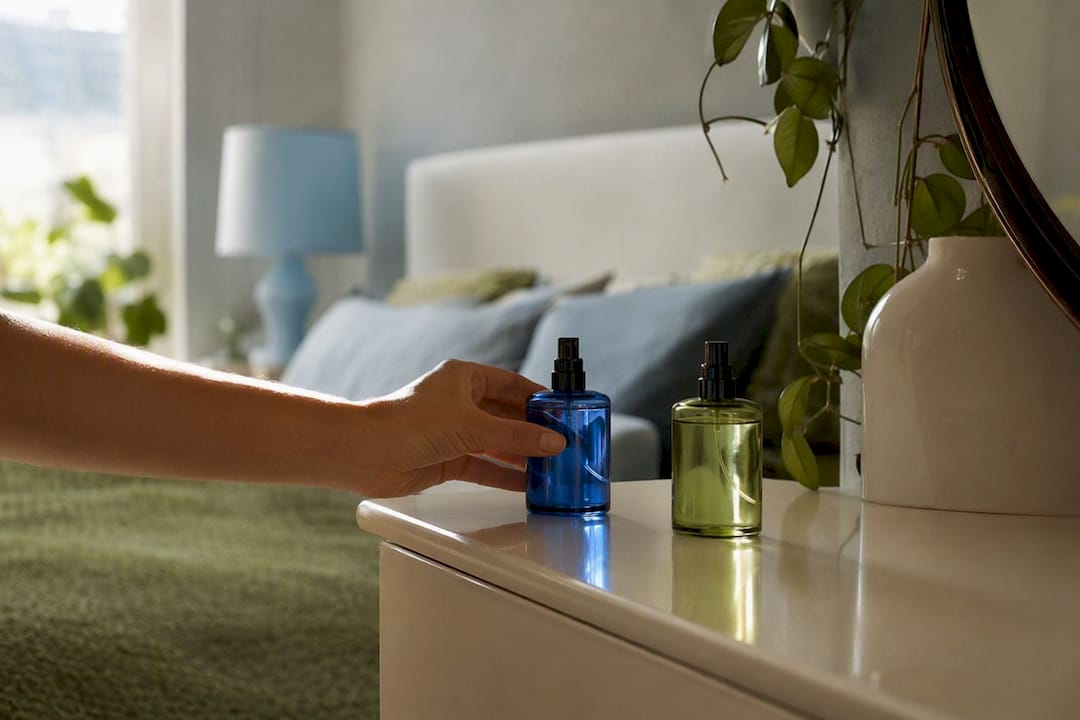
Reformulating without phthalates isn’t just a marketing exercise. Perfumers have real alternative fixatives that do similar jobs, though each comes with its own trade-offs.
Common substitutes include:
Citrates, such as triethyl citrate, which offer solvent properties similar to DEP without the phthalate structure.
Benzoates, used in some formulations for fixative properties, though they behave differently across various scent profiles.
Certain natural resins and fixatives, like benzoin or labdanum, which have been used in traditional perfumery for centuries and offer longevity through their own chemical stickiness rather than a synthetic solvent.
Isopropyl myristate and similar esters, which some formulators use as functional replacements for solubilizing fragrance oils.
Each option trades off slightly differently on cost, scent neutrality (does the fixative itself have a smell that affects the final fragrance), and how long it keeps a scent on skin. Citrates tend to be close performers to DEP, which is part of why they’ve become a popular reformulation choice. Natural resins can add subtle character to a fragrance, which some perfumers embrace and others avoid depending on the desired final scent profile.
Here’s the caveat that matters most: a “phthalate-free” label is not the same as a blanket safety guarantee. Consumer-facing explainers on phthalate-free perfume formulation are useful for understanding what brands are replacing and why, but removing one chemical class doesn’t automatically mean every remaining ingredient has been rigorously tested for long-term safety. Phthalate-free is a genuine step in the right direction, not a finish line.

If you’re weighing longevity against exposure concerns, know that some phthalate-free formulations do wear off faster than DEP-based versions, particularly in humid or hot conditions. That’s a reasonable trade for many people, but it’s worth knowing going in so you’re not surprised when a phthalate-free scent needs a midday reapplication that a phthalate-based one wouldn’t.
What Regulators Say About Phthalates in Fragrance
The regulatory picture in the United States is more permissive than many consumers assume. The FDA’s own guidance on phthalates in cosmetics confirms that DEP remains commonly used and notes that current data doesn’t support banning it outright at typical cosmetic-use levels. The agency continues to monitor safety data but hasn’t issued a blanket restriction on DEP in fragrance products.
That regulatory posture contrasts with parts of the labeling landscape. The same FDA guidance confirms that fragrance ingredients can be listed generically as “fragrance,” which means the agency’s own reassurance about safety at typical levels coexists with a labeling system that gives consumers no way to verify what “typical levels” means for the specific bottle in their hand.
Some other regions have taken more restrictive positions on specific phthalates in consumer products generally, reflecting different risk tolerance in how various regulatory bodies weigh precaution against permissiveness. The details vary by jurisdiction and by phthalate compound, so it’s worth treating this as a general pattern rather than a specific claim about any one country’s current rules.
What would change for U.S. consumers if disclosure rules tightened? A few realistic outcomes:
Mandatory itemized fragrance ingredient lists, similar to what some clean-beauty brands already do voluntarily
Concentration limits on specific phthalates in leave-on cosmetic products
Standardized third-party testing requirements before a “phthalate-free” claim could appear on packaging
Public databases linking specific products to verified ingredient disclosures
None of that exists as a current requirement, which is exactly why brand-level transparency and independent testing carry so much weight right now. Until labeling rules catch up, the burden sits more heavily on individual research than most shoppers realize.
How Essencezenith Approaches Fragrance Sourcing
Essencezenith built its curation process around a simple frustration: the ingredient panel often can’t tell you what you actually want to know. Rather than accepting “fragrance” as an unquestioned catch-all, the team asks suppliers directly about phthalate content and formulation choices before a scent earns a spot in the catalog.
That transparency-first approach shapes a few concrete practices:
Prioritizing suppliers willing to share formulation details beyond the legal minimum, rather than defaulting to whatever passes regulatory muster
Highlighting phthalate-aware fragrance options within product descriptions so shoppers don’t have to dig through a brand’s separate policy page to find the answer
Backing every purchase with a 30-day satisfaction guarantee, so if a fragrance doesn’t sit right with your skin, your nose, or your values, returning an unused item is straightforward rather than a fight
Featuring genuine customer feedback on efficacy and formulation alongside product listings, giving shoppers a second layer of information beyond marketing copy
This matters because sustainable, powerful ingredients only mean something if you can actually verify them before checkout. Essencezenith’s broader beauty catalog runs on that same principle: curating for ingredients designed to enhance natural beauty rather than simply cover concerns up, paired with a user-friendly shopping interface where product information doesn’t require a chemistry degree to interpret.
If you want a deeper walkthrough of exactly how to read a product label for the same kind of hidden-ingredient red flags discussed here, Essencezenith’s label-reading guide breaks the process down step by step, and it applies well beyond just fragrance.
Wearing Perfume Without Overthinking Every Spray
Here’s an honest reflection worth sitting with: most fragrance anxiety online swings between two extremes, either dismissing phthalates entirely or treating every spray of perfume like a hazmat situation. Neither extreme holds up against the actual evidence.
A more workable approach looks like this: save a beloved signature scent, phthalate-containing or not, for occasions where a few hours of wear genuinely matters. For daily routine, lean on scented rinse-off products and phthalate-free options where you can verify the claim through a brand’s transparency page rather than a sticker alone.
That’s not a compromise born of fear. It’s a recognition that exposure is cumulative, and the biggest wins come from trimming the routine habits that repeat every single day, not from swearing off the bottle you actually love. For readers who’d rather skip the label-detective work entirely, browsing curated phthalate-aware options can shortcut a lot of that research.
The goal isn’t perfection. It’s shifting your daily average in a better direction while still enjoying something that, frankly, makes getting dressed in the morning a little more fun.
— Norman
Shop Phthalate-Aware Fragrances With Real Purchase Protection
Essencezenith gives you something most fragrance retailers don’t: a curation process that asks suppliers the phthalate question before a product ever reaches the catalog, instead of leaving you to decode a generic “fragrance” listing on your own.

Every fragrance and beauty item on the site gets vetted for supplier transparency, and product pages flag phthalate-aware formulations where that information is available, so you’re not stuck cross-referencing lab studies just to make a confident choice. If a scent doesn’t work for your skin or your standards once it arrives, the 30-day refund policy means returning it is simple, not a hassle you have to argue your way through. Orders ship fast, and if you have questions about shipping timelines before you buy, the shipping policy page lays out exactly what to expect.
If you’ve read this far, you already know more about fragrance ingredient transparency than most shoppers. Put that knowledge to use: browse Essencezenith’s curated fragrance selection and pick something you can feel genuinely good about wearing.
Sources
For readers who want to go straight to primary evidence rather than take a summary at face value, these are worth bookmarking:
This article is general information, not a substitute for advice from a qualified doctor. Consult a qualified healthcare professional about your own circumstances before acting on anything here.
FAQ
Does every fragrance contain phthalates?
No. DEP remains commonly used, but many brands have reformulated with alternative fixatives, and some fragrances are genuinely phthalate-free; you generally can’t confirm which is true from the ingredient label alone.
What perfume brands don’t use phthalates?
Brands offering verified phthalate-free lines typically publish transparency pages or lab disclosures confirming the claim; checking a brand’s own ingredient policy is more reliable than trusting packaging language alone.
Which products tend to have the highest phthalate levels?
Testing has found phthalates most frequently in leave-on personal care products, with concentrations varying widely between products; some commercial fragrances tested at the higher end of detected ranges according to GC-MS research.
Can your body clear out phthalates on its own?
Yes, phthalates have short half-lives and your body metabolizes and excretes them relatively quickly, but daily exposure from multiple sources means many people maintain a fairly steady internal level rather than fully clearing between exposures.
Recommended
Comments