
The Role of Clinical Studies in Beauty: 2026 Guide
- Norman Church
- 6 days ago
- 8 min read

TL;DR:
Clinical studies are essential for verifying the safety and efficacy of beauty products through objective measurements and consumer feedback. Smaller brands can produce credible evidence with targeted, cost-effective studies, boosting consumer trust and market credibility. Transparency and specific data are key for consumers evaluating product claims and understanding true effectiveness.
Clinical studies in beauty are defined as structured scientific investigations that validate whether a skincare or cosmetic product is both safe and effective before claims reach consumers. The role of clinical studies in beauty goes far beyond regulatory compliance. These studies generate the measurable proof that separates a product worth buying from one that simply sounds good on a label. Devices like corneometers and cutometers now measure hydration and elasticity with quantifiable precision. Consumer demand for that kind of proof is accelerating fast, and brands that cannot show their work are losing ground to those that can.
What types of clinical studies are used in beauty and how do they work?
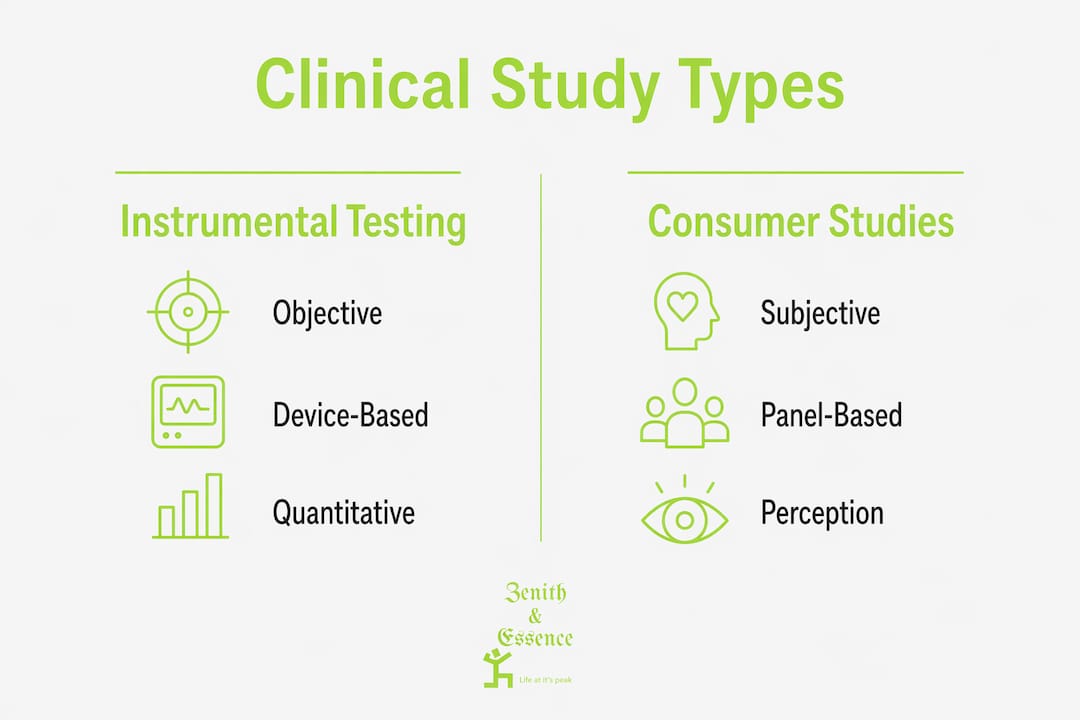
The beauty industry uses two primary study types: instrumental testing and consumer perception studies. Both serve different purposes, and the strongest clinical evidence combines them.

Instrumental testing
Instrumental testing uses calibrated devices to produce objective, reproducible data. Corneometers measure hydration and cutometers measure skin elasticity. Profilometers quantify wrinkle depth. These tools remove subjectivity from the equation entirely. A brand claiming “clinically proven hydration” backed by corneometer data is making a statement that can be verified and repeated. That is the standard worth looking for.
Consumer perception studies
Consumer perception studies recruit panels of volunteers, typically 30–50 people, who use a product over a set period and report their experience. Brands run these panels over 28 days to capture sensory feedback like texture, absorption speed, and visible improvement. This data captures what instruments cannot: how a product actually feels and whether real people notice a difference. The best studies combine both approaches, because instrumental and perception data together offer a complete picture of efficacy that neither method delivers alone.
Full trials versus targeted studies
Full clinical trials are thorough but expensive. Full clinical studies cost $40,000–$150,000, which puts them out of reach for many smaller brands. Targeted studies focused on a single ingredient or claim cost significantly less and still generate credible, usable data. This distinction matters for consumers. A brand running a focused, well-designed study on one specific outcome is often more credible than a brand making sweeping claims backed by nothing at all.
Pro Tip: When reading a product claim, look for the specific outcome measured, such as “23% increase in hydration after 28 days,” rather than vague language like “visibly improved skin.” Specific numbers signal a real study was conducted.
How do clinical studies affect beauty marketing and consumer trust?
Clinical data has become the primary currency of credibility in beauty marketing. Brands use study results to substantiate claims like “reduces wrinkle depth by 30%” or “improves skin barrier function in 4 weeks.” Without that data, those claims are legally and ethically unsupportable.
The consumer side of this shift is striking. 92% of consumers prioritize clinical testing as part of their purchasing decision. That figure reflects a fundamental change in how people shop for skincare. Consumers are no longer accepting promises at face value. They want proof, and brands that provide it convert at higher rates.
Here is what strong clinical evidence does for a brand in practice:
Differentiates in a crowded market. Thousands of moisturizers exist. One backed by a 28-day corneometer study stands apart immediately.
Reduces return rates. Products that perform as claimed generate fewer complaints and fewer returns.
Supports premium pricing. Clinically validated products command higher price points because the evidence justifies the cost.
Protects against regulatory scrutiny. Documented study results give brands a defensible record if a claim is ever challenged.
“Proof is the most defensible advantage in a skeptical, data-literate beauty market where consumers demand evidence rather than promises.” — BeautyMatter
The importance of clinical trials in skincare also extends to brand loyalty. When a product delivers what the study promised, consumers come back. That trust is built on data, not marketing copy. You can learn more about what separates credible brands from the rest by reviewing a trustworthy beauty brand checklist before you buy.
What is the regulatory landscape for clinical studies in beauty?
The regulatory framework for cosmetic clinical studies in the United States is less prescriptive than most consumers assume. The FDA does not require cosmetic products to undergo pre-market efficacy trials. FDA oversight focuses on safety and preventing misleading claims rather than mandating proof of effectiveness before a product reaches shelves.
That does not mean brands can claim anything. Here is how the legal responsibility actually works:
Manufacturers bear full responsibility for product safety and the truthfulness of every claim on the label.
Clinical studies are voluntary but become necessary the moment a brand makes a specific performance claim.
Higher-impact claims require stronger evidence. A claim like “reduces wrinkles by 40%” demands documented, reproducible data to be legally defensible.
International markets add complexity. Canada, the European Union, and other markets have their own standards for claim substantiation, and brands selling globally must meet each jurisdiction’s requirements.
Brands are legally responsible for safety and truthful claims but are not required to submit proof prior to sale. Clinical studies are the voluntary but practical tool that protects them. Clinical trials provide structured frameworks to quantify performance, monitor safety, and substantiate claims using standardized data. That structure reduces the risk of misleading claims and supports compliance across markets. Understanding your rights as a buyer is equally worth knowing. The consumer protection laws in beauty guide covers what brands are legally required to disclose and what you can do when they fall short.
How can consumers evaluate clinical evidence when choosing beauty products?
Reading clinical claims on a beauty label is a skill. Most consumers have not been taught it, but it is straightforward once you know what to look for.
The core principle is specificity. Vague claims signal weak or absent evidence. Specific, measurable claims signal a real study. Here is how to apply that in practice:
Look for numbers tied to outcomes. “Hydration increased by 28% after 4 weeks” is a clinical claim. “Deeply hydrating” is marketing language.
Check for study parameters. Credible brands disclose study size, duration, and method. “Tested on 45 volunteers over 28 days using corneometer measurements” is the kind of detail that confirms real research.
Distinguish instrumental from perception data. Instrumental data (corneometer, cutometer) is more objective. Perception data (“87% of users agreed skin felt smoother”) is valid but subjective. Both are useful. Neither alone is complete.
Be skeptical of superlatives without data. “The most effective moisturizer” is a claim that requires comparative study data to support. Without it, it is just a headline.
Look for third-party testing. Studies conducted by independent labs carry more weight than those run internally by the brand.
Pro Tip: Search the brand’s website for a “clinical studies” or “efficacy data” page. Brands serious about transparency publish their methods. If that page does not exist, treat their claims with more skepticism. You can also test beauty products online using tools and resources that help you evaluate claims before committing to a purchase.
Smaller targeted clinical studies allow indie brands to build credible, evidence-based identities without prohibitive costs. This means clinical backing is no longer exclusive to large corporations. A small brand with one well-designed study on a single hero ingredient can be more trustworthy than a legacy brand with broad, unsubstantiated claims. Size of brand does not equal quality of evidence. What matters is whether the study design matches the claim being made. Credible clinical study design begins with clearly defining the precise biological outcome to demonstrate, linking the study to the intended marketing claim from the start. That alignment is what makes a study worth trusting. For a deeper look at what clinical skincare treatments involve, the clinical skincare treatment guide from Fundamental Skin breaks down the terminology clearly.
Key takeaways
Clinical studies are the most reliable tool consumers have for separating beauty products that work from those that only claim to.
Point | Details |
Clinical studies validate claims | Instrumental testing and perception studies together produce the most complete proof of efficacy. |
92% of consumers demand proof | Consumer trust now depends on clinical evidence, not marketing language alone. |
FDA does not mandate efficacy trials | Brands are legally responsible for truthful claims but choose clinical studies voluntarily to substantiate them. |
Specificity signals credibility | Claims with measurable outcomes, study size, and duration are far more trustworthy than vague language. |
Indie brands can compete | Targeted studies costing far less than full trials give smaller brands credible, defensible evidence. |
Why clinical proof has become the real differentiator in beauty
I have spent years watching the beauty industry shift from storytelling to science, and the change is not cosmetic. Brands that invested early in clinical research now hold a structural advantage. Their claims survive scrutiny. Their customers come back. Their marketing does not collapse the moment someone asks for proof.
What surprises most people is how accessible this has become. Full clinical trials at $40,000–$150,000 are not the only option. A well-designed targeted study on a single active ingredient, run with a panel of 30–50 volunteers over 28 days, costs a fraction of that and still produces data worth publishing. Indie brands are using this to build reputations that rival legacy players. I find that genuinely exciting.
The uncomfortable truth is that most beauty marketing still operates on assertion. “Clinically proven” appears on labels where the study behind it was poorly designed, too small to be meaningful, or never disclosed publicly. Consumers who know what to ask for, specific outcomes, disclosed methods, third-party testing, are already ahead of the majority. The market will eventually catch up. Brands that cannot show their work will lose to those that can. That is not a prediction. It is already happening.
The future of beauty is one where transparency is the baseline, not the differentiator. Brands that treat clinical evidence as a marketing tool rather than a genuine commitment to efficacy will be found out. The ones building real proof into their products from the start are the ones worth your money.
— Norman
Discover clinically grounded beauty at Essencezenith

Essencezenith curates beauty products built on the same principle this article defends: evidence over assertion. Every product in the Essencezenith collection is selected for its ingredient integrity and proven performance, not just its packaging. The Herbal Magic Moisturizing Cream is a standout example, formulated with botanicals chosen for their documented skin benefits. Essencezenith backs every purchase with a 30-day satisfaction guarantee, so you shop with the same confidence a clinical study gives a brand. Explore the full range of premium beauty products and find formulations you can trust.
FAQ
What is the role of clinical studies in beauty products?
Clinical studies scientifically validate whether a beauty product is safe and effective by measuring specific outcomes like hydration, elasticity, or wrinkle depth. They provide the evidence brands need to make truthful, substantiated marketing claims.
Are beauty brands required to conduct clinical trials?
The FDA does not require cosmetic brands to conduct pre-market efficacy trials. Brands are legally responsible for product safety and truthful claims, and clinical studies are the voluntary tool most commonly used to meet that standard.
What does “clinically proven” actually mean on a label?
“Clinically proven” should mean a study was conducted using measurable methods and produced statistically significant results. Without disclosed study size, duration, and methodology, the phrase is marketing language rather than verified proof.
How do I know if a clinical claim is credible?
Look for specific numbers tied to measurable outcomes, disclosed study parameters like panel size and duration, and third-party testing. Vague language like “visibly improved” without supporting data is a sign the claim lacks rigorous backing.
Can small beauty brands afford clinical studies?
Targeted clinical studies focused on a single ingredient or claim cost significantly less than full trials and still generate credible, defensible evidence. Smaller brands regularly use this approach to build evidence-based reputations without prohibitive investment.
Recommended
Comments