
The Role of Organic Certification in Beauty Products

TL;DR:
Organic certification in beauty guarantees ingredients are grown and processed according to strict standards set by bodies like USDA Organic and COSMOS. It involves third-party audits that verify traceability, ban prohibited chemicals, and ensure compliance with specific formulation thresholds. Certification builds consumer trust, reduces exposure to synthetic chemicals, and supports environmentally sustainable farming practices.
Organic certification in beauty is a verified guarantee that ingredients are grown, processed, and formulated according to strict standards set by recognized bodies such as USDA Organic, COSMOS, and the Soil Association. These certifications go far beyond a label. They define what goes into your skincare, how it was farmed, and what synthetic chemicals are banned from the formula. As consumer demand for clean beauty grows, understanding the role of organic certification in beauty products gives you a real advantage when choosing what to put on your skin.
What standards and criteria define organic certification in beauty?
Organic certification for cosmetics follows specific, measurable thresholds. COSMOS certification requires that at least 95% of plant ingredients are organic and that the total formula contains a minimum of 20% organic content, dropping to 10% for rinse-off products like shampoos and cleansers. That distinction matters because water, which cannot be certified organic, makes up a large portion of most rinse-off formulas.

Third-party certifiers do not simply take a brand’s word for it. Certification audits include site inspections, record reviews, and final approvals that verify traceability and adherence to documented production plans. Every ingredient must be traceable back to its source farm or supplier. This chain of custody is what separates a certified product from one that simply uses the word “organic” on its packaging.
Prohibited ingredients are a defining feature of any credible certification. COSMOS organic standards ban GM ingredients, animal testing, parabens, phthalates, and require sustainable packaging. These restrictions are not optional add-ons. They are baseline requirements that every certified brand must meet before earning the seal.
Key prohibited substances under COSMOS and Soil Association standards
Synthetic parabens and phthalates
Artificial fragrances and colorants derived from petrochemicals
Genetically modified organisms (GMOs)
Ingredients tested on animals
Nanoparticles not approved under the certification framework
Pro Tip: When reading a product label, look for the specific certification seal, such as COSMOS Organic or Soil Association Organic, rather than relying on the word “organic” alone in the product name.
The difference between COSMOS Natural and COSMOS Organic is also worth knowing. COSMOS Natural allows synthetic processing of natural ingredients, while COSMOS Organic requires those ingredients to be certified organic at the source. Both are legitimate certifications, but they represent different levels of commitment to organic sourcing. Knowing this distinction helps you match the product to your personal standards.
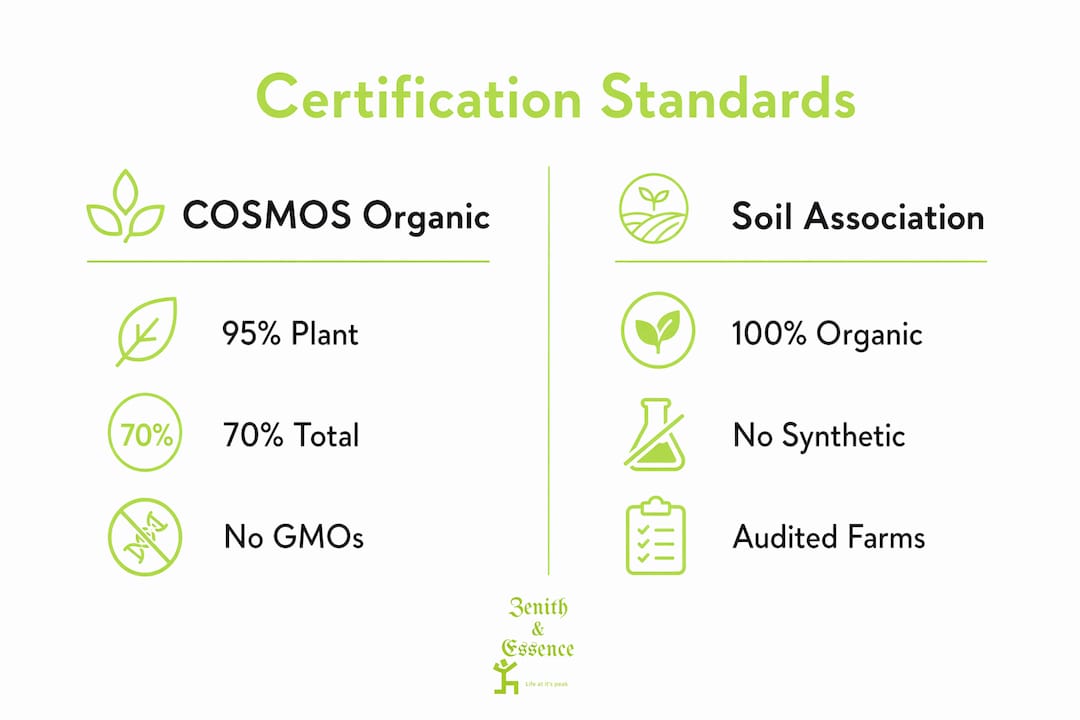
Certification standard | Minimum organic plant content | Minimum total formula organic content |
COSMOS Organic (leave-on) | 95% of plant ingredients | 20% of total formula |
COSMOS Organic (rinse-off) | 95% of plant ingredients | 10% of total formula |
USDA Organic | 95% of all ingredients | 95% of all ingredients |
COSMOS Natural | No organic requirement | No organic requirement |
How does organic certification benefit consumers and the environment?
The most direct benefit of certified organic beauty products is reduced exposure to synthetic chemicals. Organic certification restricts synthetic chemicals including parabens, phthalates, and artificial fragrances, which are common triggers for skin irritation and allergic reactions. For anyone with sensitive skin, this restriction is not a marketing claim. It is a formulation requirement backed by audit.
Skin benefits extend beyond irritation reduction. Organic plant ingredients are grown without synthetic pesticides, which means the botanical extracts in your serum or moisturizer carry fewer residual chemical compounds. Green chemistry principles align closely with organic certification because both approaches prioritize ingredient safety and environmental impact at the formulation stage.
The environmental case for certified organic beauty is equally strong. Organic farming supports cleaner waterways, healthier soils, and carbon storage, all of which contribute to long-term ecological health. Choosing certified products connects your purchase to a farming system that actively reduces pollution. That is a measurable outcome, not a vague sustainability claim.
“Organic certification builds consumer trust and prevents deceptive marketing practices, giving shoppers reliable access to truly natural and sustainable beauty products.” — Frontiers in Plant Science, 2025
Greenwashing is a real and widespread problem in the beauty industry. Without certification, any brand can print “natural” or “organic” on its packaging without meeting a single standard. Certification protects consumers from this kind of deceptive marketing by requiring independent verification before a seal can appear. That independent check is the core value of the entire certification system.
The sustainable beauty connection runs deeper than packaging claims. Certified organic brands commit to sourcing, farming, and processing practices that reduce the total environmental footprint of a product from field to shelf.
What challenges and nuances exist in organic beauty certification?
Organic certification is not a perfect system, and knowing its limitations makes you a sharper shopper. Certification audit costs and regulatory recordkeeping create real barriers for small producers. A small independent brand with genuinely clean formulas may lack the budget to pursue COSMOS or Soil Association certification, while a large corporation can absorb those costs easily. This means the absence of a seal does not automatically mean a product is lower quality.
Without third-party certification seals, organic claims on cosmetics carry no legal enforcement in the United States. The word “organic” is tightly regulated for food under USDA rules, but cosmetics face a much looser standard. A brand can legally call a product “organic” without a single certified ingredient. That gap between food and cosmetics regulation is one of the most important facts any beauty shopper can know.
Large corporate players entering the certified organic market create another challenge. Certification value dilution from major industrial brands can blur the distinction between genuinely small-batch organic producers and mass-market products that simply meet the minimum threshold. The certification standard stays the same, but the spirit behind it can vary widely.
Common pitfalls to watch for
Products labeled “made with organic ingredients” do not meet full COSMOS or USDA Organic standards
“Natural” is not a regulated term and carries no certification requirement
A product can contain one certified organic ingredient and still market itself as organic
Certification seals can be faked; always verify on the certifying body’s official website
Pro Tip: Cross-check any certification seal you see on a product by searching the brand name on the COSMOS or Soil Association’s official certified brand database. Verification takes under two minutes and removes all doubt.
How to identify trustworthy organic certification labels
Recognizing a credible certification label is a skill that pays off every time you shop. These steps give you a reliable process for evaluating any organic beauty claim.
Look for named certification seals. COSMOS Organic, Soil Association Organic, and USDA Organic are the three most recognized standards globally. Each has a distinct logo that appears on certified packaging.
Check the certifying body’s database. Every major certifier maintains a public list of approved brands and products. If a brand claims certification but does not appear in the database, the claim is unverified.
Read the ingredient list alongside the label. A certified product will list its organic ingredients with an asterisk or note indicating certification. The absence of this notation on a product claiming organic status is a red flag.
Assess brand transparency. Certified brands typically publish their sourcing information, supplier relationships, and audit history. Brands that resist sharing this information are worth questioning.
Use consumer protection resources. The 2026 consumer protection guide for beauty covers how certifications contribute to product credibility and what legal protections apply to cosmetic claims.
Checking a brand against a trustworthy beauty brand checklist adds another layer of confidence. Certification is one criterion, but transparency, sourcing disclosure, and third-party testing all reinforce each other. No single signal is enough on its own.
Certified organic operations increased by more than 90% between 2011 and 2021, reaching 17,445 farms. That growth reflects expanding supply, which means certified organic ingredients are more available and more affordable than they were a decade ago. The barrier to sourcing certified organic inputs has dropped, making it harder for brands to justify avoiding certification on cost grounds alone.
Key Takeaways
Organic certification in beauty is the single most reliable tool consumers have for verifying that a product’s ingredients meet documented safety, sourcing, and environmental standards.
Point | Details |
Certification sets real thresholds | COSMOS Organic requires 95% organic plant content and at least 20% organic total formula for leave-on products. |
Prohibited ingredients are non-negotiable | Certified products ban parabens, phthalates, GMOs, and animal testing by standard, not by brand choice. |
“Organic” without a seal is unverified | No U.S. law requires cosmetics to prove organic claims unless they carry a recognized third-party certification seal. |
Small brands face real cost barriers | Audit and recordkeeping costs can exclude genuinely clean small producers from the certified market. |
Verification takes two minutes | Check any certification claim against the COSMOS or Soil Association’s public brand database before buying. |
Why I think most shoppers underestimate certification
After years of following the beauty industry closely, I keep coming back to the same observation: most shoppers treat certification as a bonus rather than a baseline. They scan for it, feel reassured when they see it, and move on. What they rarely do is ask what the certification actually required.
The gap between COSMOS Natural and COSMOS Organic is a perfect example. Both carry the COSMOS name. Both look credible on a shelf. But one requires organic sourcing at the ingredient level and the other does not. A shopper who does not know that distinction is making a less informed choice, even while trying to make a good one.
What I find genuinely encouraging is the growth in certified organic farming supply. More certified farms mean more certified ingredients, which means brands have fewer legitimate excuses for skipping certification. The cost argument that held water in 2015 is weaker in 2026. Brands that still avoid third-party certification while using organic language in their marketing deserve more scrutiny, not less.
The future of organic certification in beauty will likely involve stricter digital traceability, where consumers can scan a code and trace an ingredient back to its source farm in real time. That kind of transparency is already emerging in food. Beauty is not far behind. When it arrives, the brands that built genuine certification practices early will have a clear advantage. The ones that relied on loose language will have nowhere to hide.
— Norman
Certified organic beauty, curated for you at Essencezenith
Essencezenith selects products based on ingredient quality, sourcing transparency, and verified standards, so you spend less time decoding labels and more time finding what actually works for your skin.

Every product in the Essencezenith catalog is chosen with the same criteria you just read about: real ingredient standards, honest sourcing, and no tolerance for vague claims. The best practices for buying beauty online guide pairs well with the selection you will find on the site. Essencezenith also backs every purchase with a 30-day satisfaction guarantee, so you can try certified organic skincare without risk. Browse the full collection at Essencezenith and shop with the confidence that comes from knowing exactly what is in your products.
FAQ
What is organic certification in beauty products?
Organic certification in beauty verifies that a product’s ingredients were grown and processed according to documented standards set by bodies like COSMOS, Soil Association, or USDA Organic. It requires third-party audits and prohibits synthetic chemicals such as parabens, phthalates, and GMOs.
How does organic certification impact skincare safety?
Certified organic skincare bans synthetic irritants including parabens and artificial fragrances, reducing the risk of allergic reactions and chemical exposure. This restriction is a formulation requirement, not a marketing claim.
What is the difference between vegan and organic beauty certification?
Vegan certification confirms no animal-derived ingredients or animal testing, while organic certification verifies ingredient sourcing and farming standards. A product can be vegan without being organic, and organic without being vegan.
Can a brand legally call a product organic without certification?
In the United States, cosmetics are not legally required to prove organic claims without a third-party certification seal. The word “organic” in a product name or description carries no legal enforcement unless the product holds USDA Organic or equivalent certification.
How do I verify an organic certification seal is real?
Search the brand name on the official COSMOS, Soil Association, or USDA Organic certified brand database. Each certifying body maintains a public list of approved products, and verification takes under two minutes.
Recommended
Comments