
What Is Clean Beauty? Your No-Nonsense 2026 Guide

TL;DR:
Clean beauty is an unregulated term, so consumers must verify safety claims through third-party certifications and full ingredient lists.
It is essential to distinguish clean from natural, organic, or sustainable labels, as they focus on different priorities and may include synthetic ingredients.
Clean beauty is defined as personal care products formulated without ingredients known or suspected to harm human health, with a focus on safety, transparency, and ethical sourcing. The term has no universal regulatory definition, which means any brand can use it freely. That gap creates real confusion for anyone trying to identify truly clean beauty products. The Clean Beauty Coalition describes clean beauty as a commitment to ingredient safety, ethical practices, and inclusivity, not just a marketing label. Understanding what the phrase actually means is the first step toward making smarter choices at the shelf.
What is clean beauty and why does it lack a legal definition?
Clean beauty has no FDA definition and no global government standard as of 2026. That single fact explains why two products can both carry the “clean” label while sharing almost no formulation principles. Brands have full autonomy to define “clean beauty” for marketing purposes, which leads to inconsistent claims and genuine consumer confusion.
Four main frameworks currently fill the regulatory void:
Brand-defined avoid lists. A brand decides which ingredients it will not use, often based on internal research or consumer demand. There is no independent review.
Retailer standards. Programs like Sephora’s Clean at Sephora restrict over 50 ingredients but are set by merchandising teams, not scientific committees, and can change without notice.
Third-party certifications. EWG Verified and MADE SAFE require independent audits and apply stricter criteria. They are the most rigorous option but remain least used by mass-market brands.
Community-driven guidelines. Advocacy groups and online communities publish their own restricted ingredient lists, which vary widely in scientific rigor.
Each framework carries a different level of accountability. A retailer ban is better than nothing, but a third-party certification like EWG Verified or MADE SAFE involves actual ingredient audits. The difference matters when you are deciding which label to trust.
Pro Tip: Regulatory ambiguity is a marketing opportunity. When a brand’s only clean credential is its own avoid list, treat that claim the same way you would treat a self-graded exam.
How to identify truly clean beauty products
Identifying genuinely safer products requires looking past the front label entirely. Front-label buzzwords like “pure,” “non-toxic,” and “chemical-free” carry no legal weight. Every chemical, including water, is technically a chemical, so “chemical-free” is scientifically meaningless.
Follow these steps when evaluating a product:
Check for credible third-party certifications. Look for EWG Verified, MADE SAFE, or Leaping Bunny, which is the most rigorous cruelty-free certification available. Self-reported cruelty-free claims without third-party verification add little confidence.
Read the full INCI ingredient list. The International Nomenclature of Cosmetic Ingredients (INCI) list is the standardized format for all cosmetic ingredients. Start from the bottom, where lower-concentration ingredients appear, and scan for anything flagged by EWG’s Skin Deep database.
Watch for hidden fragrance. “Fragrance” or “parfum” on an ingredient list often hides proprietary chemical mixtures that may include allergens or endocrine disruptors. A brand committed to transparency will name individual fragrance components or use certified fragrance-free formulas.
Look for concentration disclosures. Brands that voluntarily share the percentage of actives like retinol or vitamin C signal greater transparency and higher formulation accountability. Generic “contains retinol” claims tell you nothing about efficacy or safety at the dose used.
Assess packaging. Airless pumps and opaque containers protect formulas from oxidation and contamination. Products in clear jars exposed to light and air degrade faster, which can change the safety profile of active ingredients over time.
Pro Tip: A “paraben-free” label does not mean a product is overall safer. Brands sometimes replace parabens with preservatives that carry their own concerns. Judge the full formula, not a single omission.
The trustworthy brand checklist from Essencezenith covers nine criteria for evaluating brand credibility, including certification verification and ingredient sourcing transparency.
Is clean beauty the same as natural, organic, or sustainable?
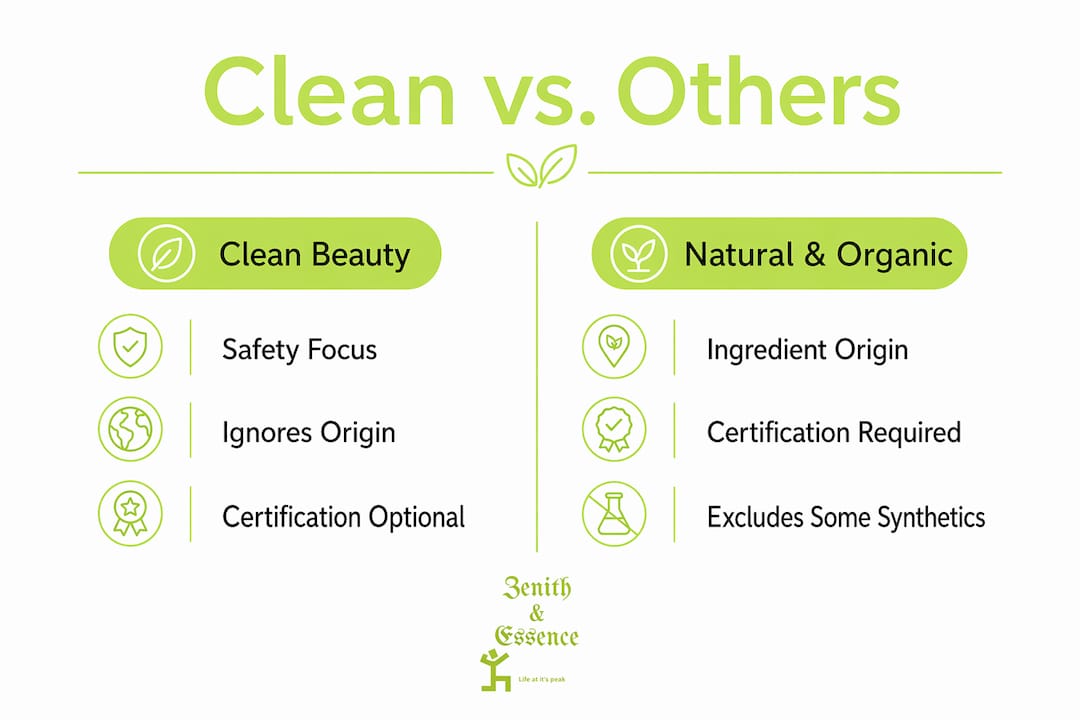
Clean beauty is not synonymous with natural, organic, vegan, cruelty-free, or sustainable beauty. Each term describes a different set of priorities, and confusing them leads to poor purchasing decisions.
Label | Primary focus | Synthetic ingredients allowed? | Requires certification? |
Clean beauty | Ingredient safety and ethics | Yes, if safe | No universal standard |
Natural beauty | Ingredient origin (plant or mineral) | Rarely | Sometimes (COSMOS Natural) |
Organic beauty | Certified organic ingredient sourcing | No | Yes (USDA, COSMOS Organic) |
Sustainable beauty | Environmental impact and sourcing | Yes | Sometimes (B Corp) |
Vegan beauty | No animal-derived ingredients | Yes | Sometimes (Vegan Society) |
Cruelty-free | No animal testing | Yes | Sometimes (Leaping Bunny) |
The most important distinction is that clean beauty focuses on safety rather than ingredient origin. A product can be 100% natural and still contain ingredients that irritate skin or disrupt hormones. Poison ivy is natural. That does not make it safe for your face.
Some synthetic ingredients are actually safer and more stable than their natural counterparts. Synthetic vitamin C derivatives, for example, are less likely to oxidize and cause irritation than raw ascorbic acid at high concentrations. A clean beauty product can include safe synthetics without compromising its core commitment to safety.
Sustainable beauty adds another layer by addressing environmental impact, packaging waste, and supply chain ethics. A product can be clean without being sustainable, and vice versa. For a deeper look at how sustainability standards work in personal care, the sustainable beauty guide from Essencezenith breaks down what the label actually requires.
Health equity and clean beauty: who carries the real risk?
Clean beauty is not just a wellness trend. For many communities, it is a health justice issue. Black women are exposed to 80% more toxic beauty ingredients than white women, and 1 in 12 products marketed to Black women is ranked as highly hazardous. That disparity reflects decades of product development that prioritized certain markets while ignoring the safety of others.
“The clean beauty movement must center health equity. Ingredient safety is not a luxury concern. It is a public health issue that falls hardest on communities with the least regulatory protection.” — Clean Beauty Coalition
The Clean Beauty Coalition works to raise ingredient safety standards and educate consumers, with a specific focus on communities facing disproportionate exposure. Their advocacy connects ingredient transparency directly to public health outcomes, not just personal preference.
The clean beauty movement remains in a transitional state between marketing hype and formal standard-setting. That transition is partly driven by health equity advocates who argue that voluntary brand standards are not enough when vulnerable populations bear the greatest risk. Consumer pressure, purchasing choices, and support for brands with genuine third-party accountability all push the industry toward higher standards.
Understanding consumer protection laws in beauty helps clarify what legal protections currently exist and where the gaps remain for shoppers in the U.S.
Key takeaways
Clean beauty is an unregulated term that requires consumers to verify safety claims through third-party certifications, full ingredient list scrutiny, and brand transparency rather than front-label marketing.
Point | Details |
No legal definition exists | “Clean beauty” has no FDA or global regulatory standard, so brand claims vary widely. |
Third-party certifications matter | EWG Verified, MADE SAFE, and Leaping Bunny provide independent verification that self-reports cannot. |
Fragrance is a red flag | “Fragrance” or “parfum” on an INCI list can hide dozens of undisclosed chemical compounds. |
Clean does not mean natural | Safe synthetic ingredients are common in clean formulas and often outperform natural alternatives. |
Health equity is central | Black women face disproportionately higher toxic ingredient exposure, making clean beauty a public health concern. |
Why “clean” still means something, even without a rulebook
The absence of regulation frustrates me, but it does not make clean beauty meaningless. What it means is that the burden falls on the consumer to do the work that regulators have not done yet.
I have spent years watching brands slap “clean” on products that contain fragrance cocktails, undisclosed preservatives, and ingredients with real safety questions. The label alone tells you nothing. What tells you something is a full INCI list, a third-party certification, and a brand willing to disclose actual ingredient concentrations.
The clean beauty movement is genuinely evolving. The shift from marketing buzzword to formalized standards is slow, but it is happening. EWG Verified and MADE SAFE are raising the bar. Health equity advocates are forcing the conversation beyond skin type and into systemic risk. That is real progress.
My honest advice: treat “clean” as a starting point, not a conclusion. Use it to find brands worth investigating further. Then check the certifications, read the ingredient list, and look for concentration disclosures. A brand that shares its full formula has nothing to hide. A brand that hides behind a front-label claim usually does.
The future of clean beauty depends on consistent industry regulation. Until that arrives, an informed consumer is the best quality control available.
— Norman
Essencezenith and the clean beauty standard
Essencezenith curates products built around the principles that clean beauty actually requires: ingredient transparency, ethical sourcing, and formulations designed to work without compromising safety.
Every product in the Essencezenith collection is selected with sustainability and efficacy in mind, not just marketing appeal. Shoppers can read full ingredient details, access genuine customer feedback, and shop with the confidence of a 30-day satisfaction guarantee on unused items. For anyone ready to move past marketing claims and shop with real criteria, Essencezenith’s beauty collection is a practical place to start. Transparency is not a feature here. It is the baseline.
FAQ
What is the clean beauty definition in simple terms?
Clean beauty refers to personal care products formulated without ingredients known or suspected to harm human health. The term has no official regulatory definition, so standards vary by brand and retailer.
Is clean beauty actually safe?
Clean beauty products are not automatically safer than conventional ones. Safety depends on the full formula, not the label. Third-party certifications like EWG Verified or MADE SAFE provide the most reliable safety verification.
What ingredients are considered clean?
Clean formulas typically avoid parabens, phthalates, formaldehyde-releasing preservatives, synthetic fragrances, and certain heavy metals. Safe synthetic ingredients are often permitted when they improve stability or efficacy.
How do I identify truly clean beauty products?
Check for credible third-party certifications, read the full INCI ingredient list, and look for brands that disclose active ingredient concentrations. Avoid products that list “fragrance” or “parfum” without further detail.
How does clean beauty differ from conventional beauty?
Conventional beauty products are formulated to meet basic safety regulations without restricting specific ingredient categories. Clean beauty applies a higher, self-imposed or third-party-verified standard that excludes ingredients with known or suspected health risks.
Recommended
Comments