
What Does Non-Toxic Beauty Mean for Your Skin?

TL;DR:
Non-toxic beauty products are formulated without ingredients known or suspected to harm health or the environment, but the term lacks legal regulation. ingredient safety depends on dose, concentration, and frequency of use, so labeling claims should be approached with skepticism. Transparency, third-party certification, and ingredient lists are the best ways to verify product safety and avoid greenwashing.
Non-toxic beauty is defined as skincare and cosmetics formulated without ingredients known or suspected to harm human health or the environment. The term sounds reassuring, but it carries no federal legal definition, which means any brand can print it on a label without meeting a single safety standard. The FDA regulates cosmetic safety broadly, and the FTC’s Green Guides under 16 CFR 260.10 require that unqualified “non-toxic” claims be backed by competent scientific evidence. Enforcement, however, remains inconsistent. That gap between marketing language and verified safety is exactly what every informed shopper needs to understand before buying.
What does non-toxic beauty mean in practice?
Non-toxic beauty, in practice, means a product has been formulated by excluding a defined list of ingredients that research links to health or environmental harm. The term is not certified by any government agency. No federal body audits a brand’s formula before it earns the label. That regulatory gap matters because brands apply the term variably with no government oversight enforcing ingredient use or safety claims. One brand’s “non-toxic” formula may exclude 10 ingredients; another may exclude 200.
The legal risk for brands making unsubstantiated claims is real, even if enforcement is uneven. A court approved a $1.5 million settlement in october 2025 requiring Rust-Oleum to remove “non-toxic” from Krud Kutter packaging. That ruling signals that consumer protection law can catch up with misleading labels. Knowing this helps you read marketing claims with appropriate skepticism.
Which ingredients do non-toxic products leave out?
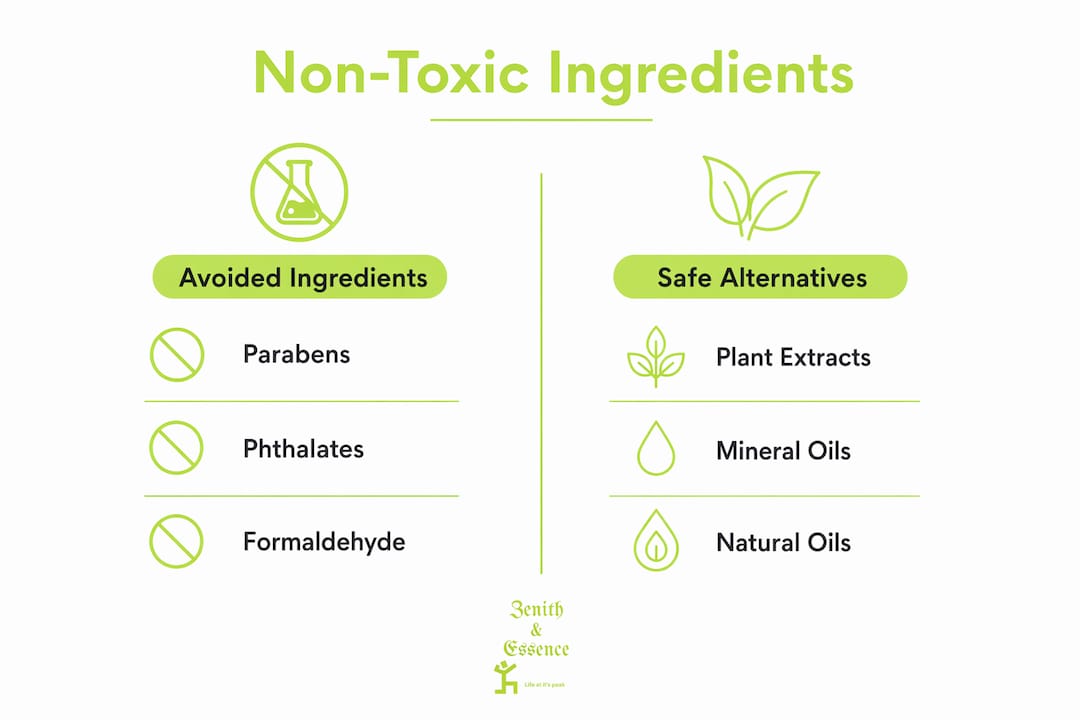
The most commonly excluded ingredients fall into five categories, each linked to specific health concerns.
Parabens (methylparaben, propylparaben): Synthetic preservatives that mimic estrogen in the body. Regulators in the European Union have restricted several parabens in leave-on cosmetics, though US rules remain less restrictive.
Phthalates (dibutyl phthalate, diethyl phthalate): Plasticizers used to make fragrance last longer. Research links phthalate exposure to endocrine disruption.
Synthetic fragrance blends: A single “fragrance” listing on a label can contain dozens of undisclosed chemicals, including allergens and sensitizers. This is one of the most common hidden sources of irritants in beauty products.
Petroleum-based fillers (mineral oil, petrolatum in some formulations): These can create a barrier on skin but offer no active benefit, and some grades contain impurities classified as possible carcinogens.
Formaldehyde releasers (DMDM hydantoin, quaternium-15): Preservatives that slowly release formaldehyde, a known human carcinogen, over a product’s shelf life.
Commonly avoided harmful ingredients include all five categories above, and reputable brands typically disclose their exclusion lists publicly. Ingredient safety assessment in beauty formulations draws on toxicology data, dermatological studies, and regulatory databases like the EU Cosmetics Regulation ingredient list and the Environmental Working Group’s Skin Deep database.
Pro Tip: When reading a label, search for “fragrance” or “parfum” near the bottom of the ingredient list. If you see it without a disclosure of individual components, the product may contain undisclosed sensitizers regardless of any non-toxic claim on the front.
Is ingredient safety really a yes-or-no question?
Ingredient safety is not binary. Toxicology experts confirm that safety is a spectrum governed by dose, concentration, and frequency of use, not by whether an ingredient sounds natural or synthetic.
“The dose makes the poison” is the foundational principle of toxicology, first articulated by Paracelsus in the 16th century. Applied to beauty products, it means that an ingredient harmful at high concentrations may be completely safe at the trace levels used in a well-formulated product. Conversely, a “natural” ingredient like essential oil of bergamot can cause phototoxic burns at concentrations above 0.4%.
Three factors determine whether an ingredient poses a real risk:
Dose: The concentration in the finished formula. Retinol at 0.025% behaves very differently from retinol at 1%.
Exposure route: A rinse-off shampoo has far less skin contact time than a leave-on serum. The same ingredient can be safe in one format and problematic in another.
Frequency: Daily use of a product compounds exposure over months and years. Ingredients that are safe for occasional use may accumulate to concerning levels with daily application.
This is why the phrase “chemical-free” is scientifically meaningless. Every ingredient, including water, is a chemical. The real question is whether the specific chemical, at the specific dose, in the specific formula, poses a risk to the person using it. Learning to identify quality beauty ingredients requires understanding these distinctions, not just memorizing a list of scary-sounding names.
Pro Tip: Check whether a brand publishes its safety assessment methodology or references third-party toxicology reviews. A brand that explains its formulation rationale is more credible than one that simply lists what it excludes.
How does non-toxic beauty differ from clean, natural, and organic?
Consumers routinely conflate clean, natural, organic, and non-toxic terminology, but these terms represent fundamentally different concepts. Understanding the distinctions protects you from paying a premium for a label that means less than you think.
Term | What it technically means | Regulated? |
Non-toxic | Free from ingredients with known health risks | No federal standard |
Clean beauty | Brand-defined exclusion list, varies widely | No federal standard |
Natural | Ingredients derived from natural sources | No federal standard |
Organic | Ingredients grown without synthetic pesticides | USDA certified (for agricultural ingredients only) |
The key insight from this table is that only “organic” carries a government-backed certification, and even that applies only to the agricultural origin of ingredients, not to the safety of the finished product. A product can be 100% organic and still cause skin reactions if it contains high concentrations of allergenic plant extracts.
“Clean beauty” deserves special attention because it is the term most often used interchangeably with non-toxic. The clean beauty guide at Essencezenith explains that clean beauty typically refers to a brand’s self-defined ingredient restriction list, which may or may not align with toxicology evidence. Some brands define clean as excluding 1,500 ingredients; others exclude 30. Neither list is legally binding.
Non-toxic focuses on health risk avoidance based on toxicology data.
Clean focuses on brand-defined ingredient restrictions, often influenced by consumer perception.
Natural focuses on ingredient origin, with no safety implication.
Organic focuses on agricultural production methods, certified by the USDA for qualifying ingredients.
How can you identify products that are genuinely safer?
Shifting from trusting marketing claims to verifying ingredient transparency is the most effective strategy for finding safer beauty products. Labels are marketing tools. Ingredient lists are the actual record of what goes on your skin.
Practical steps for evaluating a product:
Read the full ingredient list (INCI list): Ingredients are listed in descending order of concentration. The first five ingredients make up the bulk of the formula.
Look for third-party certifications: Organizations like the Environmental Working Group (EWG Verified), MADE SAFE, and NSF International certify products against defined safety criteria. These certifications require ingredient disclosure and toxicology review.
Recognize greenwashing signals: Vague claims like “all-natural,” “pure,” or “gentle” with no ingredient list or certification are red flags. So is a brand that lists what it excludes but refuses to disclose what it includes.
Use credible ingredient databases: The EWG Skin Deep database and the CosDNA database rate individual ingredients by hazard level and link to supporting research.
Check brand transparency practices: Does the brand publish its full formulation philosophy? Does it respond to ingredient questions? Transparency is a behavior, not just a label.
The consumer protection laws governing beauty claims are evolving, but they still leave significant gaps. Until regulation catches up, your best protection is reading ingredient lists and cross-referencing them against reliable databases.
Pro Tip: Use the trustworthy brand checklist at Essencezenith to evaluate any beauty brand against nine concrete criteria before you buy. It takes less than five minutes and removes most of the guesswork from label reading.
Key Takeaways
Non-toxic beauty is a marketing term with no federal legal definition, so ingredient transparency and third-party certification are the only reliable measures of product safety.
Point | Details |
No legal definition exists | “Non-toxic” is unregulated, meaning brands set their own standards without government oversight. |
Five key ingredients to avoid | Parabens, phthalates, synthetic fragrance, petroleum fillers, and formaldehyde releasers are the most commonly excluded. |
Safety is dose-dependent | An ingredient’s risk depends on concentration, exposure route, and frequency, not just its name. |
Terms mean different things | Non-toxic, clean, natural, and organic each have distinct meanings; only organic carries a government-backed certification. |
Transparency beats labels | Full ingredient disclosure and third-party certification are more reliable than any front-of-pack marketing claim. |
Why I think “non-toxic” labels deserve more skepticism than they get
I’ve spent years reading beauty labels, and the single most common mistake I see is treating “non-toxic” as a seal of approval rather than a starting point for investigation. The term is doing a lot of emotional work for very little regulatory backing. Shoppers feel safer. Brands charge more. Neither outcome is necessarily connected to the actual formula.
What changed my thinking was learning that market greenwashing, or “cleanwashing,” is widespread enough that ingredient lists are the true source of product truth. A brand can exclude parabens and still load a formula with undisclosed fragrance chemicals that trigger contact dermatitis. The exclusion list tells you what’s missing. It doesn’t tell you what’s present.
My honest advice: treat “non-toxic” the same way you’d treat “artisan” on a food label. It signals intent, not verification. The brands worth trusting are the ones that show their work, publish their full ingredient rationale, and invite scrutiny. Skeptical but informed shoppers are the market force that will eventually push the industry toward real standards.
— Norman
Essencezenith’s approach to safer beauty choices
Essencezenith curates beauty products with a focus on ingredient quality and full transparency, so you never have to guess what you’re putting on your skin.

Every product in the Essencezenith catalog is selected based on ingredient integrity, not just marketing language. The editorial team publishes detailed guides on reading labels, evaluating brands, and understanding what certifications actually mean. Shoppers also benefit from a 30-day satisfaction guarantee, which means you can return any unused item if a product doesn’t meet your expectations. For shoppers who want reliable, effective products without the label confusion, Essencezenith is the place to start.
FAQ
What does non-toxic beauty mean exactly?
Non-toxic beauty refers to skincare and cosmetic products formulated without ingredients known or suspected to cause harm to human health or the environment. The term has no federal legal definition, so standards vary by brand.
Are non-toxic beauty products actually safe?
Most non-toxic products are formulated with safety in mind, but the label alone does not guarantee safety. Ingredient safety depends on dose, concentration, and frequency of use, so reading the full ingredient list matters more than the front-of-pack claim.
What is the difference between clean beauty and non-toxic beauty?
Clean beauty is a brand-defined term referring to a self-imposed ingredient restriction list, while non-toxic beauty focuses on avoiding ingredients with documented health risks. Neither term is regulated by a federal agency.
How do I spot greenwashing in beauty products?
Look for vague claims like “pure” or “gentle” with no supporting ingredient list or third-party certification. Brands that list exclusions but hide their full ingredient list are a common greenwashing signal.
Does the FTC regulate non-toxic beauty claims?
The FTC’s Green Guides require that unqualified “non-toxic” claims be backed by competent and reliable scientific evidence, but enforcement is inconsistent. A $1.5 million settlement against Rust-Oleum in 2025 shows that legal consequences are possible for unsubstantiated claims.
Recommended
Comments