
Why Microplastics in Beauty Products Are Harmful

Why microplastics are harmful in beauty: the core problem
Microplastics in cosmetics are not a fringe concern. They penetrate your skin barrier, carry concentrated toxic chemicals into your body, and persist in ecosystems for centuries. The harm runs in two directions at once: inward, through biological disruption, and outward, through environmental contamination that eventually circles back to you through food and water.
Here is what the science has established so far:
Microplastics in cosmetics include intentionally added microbeads (polyethylene, polypropylene) used as exfoliants, as well as synthetic polymers like nylon, polyacrylates, and silicones added to improve texture, spreadability, and shelf life.
Particles as small as 70 nm can cross damaged skin and accumulate in the dermis, triggering immune responses.
Microplastics act as chemical sponges, concentrating environmental pollutants like PCBs and PBDEs at levels far exceeding the surrounding environment.
Once they enter wastewater, most treatment plants cannot fully remove them, releasing them into rivers, oceans, and eventually the food supply.
Documented health effects include oxidative stress, DNA damage in skin cells, gut microbiota disruption, and endocrine interference from leached plasticizers.
The scale of the problem is not hypothetical. It is already measurable in human blood, breast milk, and lung tissue.
Table of Contents
Where cosmetic microplastics come from and how you are exposed
How cosmetic microplastics damage marine and freshwater ecosystems
Sustainable alternatives and what consumers are pushing for in 2026
What science still does not know about microplastics and health
How beauty product microplastics specifically affect marine and land ecosystems
Essencezenith curates beauty without the microplastic compromise
Where cosmetic microplastics come from and how you are exposed
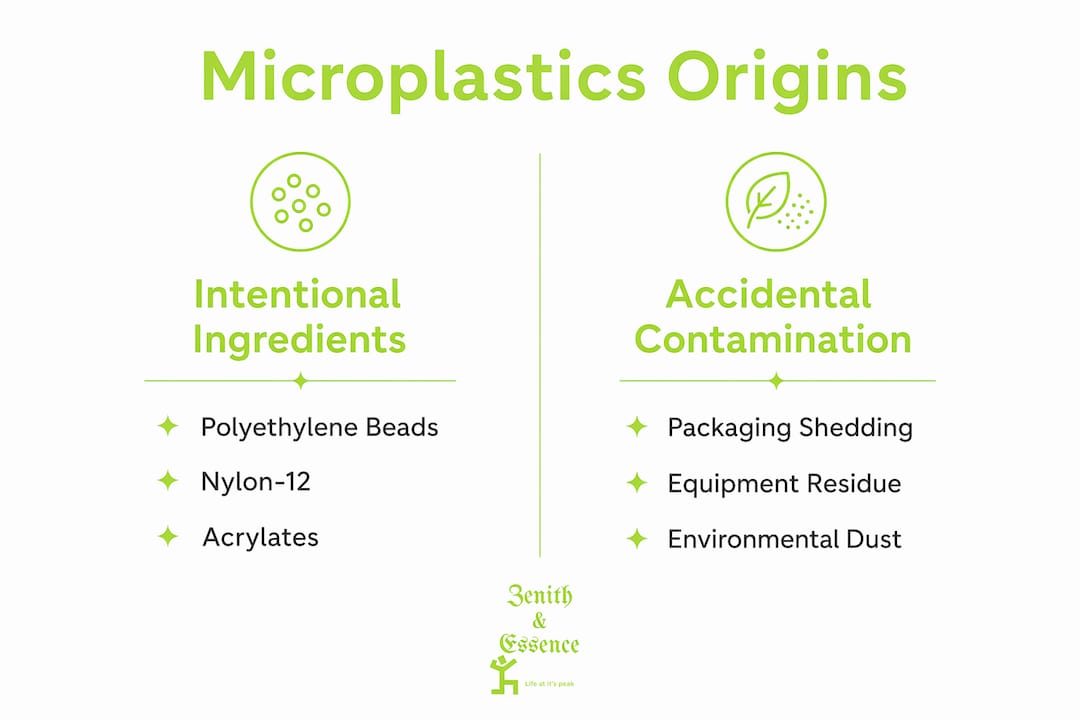
Intentional ingredients versus accidental contamination
Cosmetic manufacturers add microplastics deliberately for specific functional reasons. Polyethylene microbeads create the gritty texture in face scrubs. Polyacrylates form the film that makes mascara water-resistant. Nylon powder gives foundations a silky finish. These are design choices, not accidents.
Accidental contamination is a separate pathway. Plastic packaging sheds microscopic fragments into product formulations over time, particularly when products are stored in heat or exposed to UV light. Environmental microplastics also contaminate raw ingredients sourced from polluted water or soil.
How microplastics enter your body from beauty products
Exposure route | Products involved | Key mechanism |
Dermal absorption | Creams, serums, foundations, sunscreens | Particles penetrate through follicles and compromised skin |
Inhalation | Sprays, dry shampoos, setting powders | Aerosolized particles reach the respiratory tract |
Ingestion | Lip products, toothpaste, mouthwash | Direct oral contact and accidental swallowing |
Secondary ingestion | All rinse-off products | Microplastics enter water supply and food chain |
Leave-on products like moisturizers and serums present a higher systemic exposure risk than rinse-off products like cleansers, simply because contact time is longer. A face cream worn for 12 hours gives particles far more opportunity to interact with your skin than a cleanser rinsed off in 30 seconds.
Wastewater treatment plants remove only a fraction of microbeads from rinse-off cosmetics. Tens of thousands of microbeads can pass through treatment per single cleansing event, flowing directly into freshwater systems and coastal waters.
Pro Tip: Check ingredient lists for polyethylene (PE), polypropylene (PP), nylon-12, acrylates copolymer, and carbomer. These are among the most common synthetic polymer entries in cosmetic formulations.
How cosmetic microplastics damage marine and freshwater ecosystems
Microplastics from beauty products do not disappear after they leave your drain. They are among the most persistent synthetic pollutants in aquatic environments, and their ecological footprint is disproportionate to their size.
Aquatic ingestion: Fish, shellfish, zooplankton, and filter feeders like mussels ingest microplastics, mistaking them for food. Particles accumulate in digestive tracts, reducing feeding drive and reproductive success.
Pollutant delivery: Microplastics adsorb toxic pollutants like PCBs and PBDEs at concentrations up to 10^6 times higher than the surrounding water, then release those chemicals inside organisms after ingestion.
Terrestrial spread: Microplastics in sewage sludge applied to agricultural land contaminate soil ecosystems, affecting earthworms, soil bacteria, and plant root systems.
Biodiversity pressure: Chronic microplastic exposure reduces reproductive rates in marine invertebrates and disrupts hormonal signaling in fish, compressing population viability over generations.
Food source contamination: Shellfish consumed by humans, particularly oysters and mussels, concentrate microplastics from surrounding water, creating a direct route back into the human diet.
The persistence problem: Unlike organic pollutants that degrade over years or decades, most synthetic plastic polymers used in cosmetics resist biological breakdown entirely. They fragment into smaller and smaller pieces but do not mineralize, meaning every microbead ever washed down a drain still exists somewhere in the environment.
The cosmetics industry’s contribution to aquatic microplastic load is not trivial. Rinse-off personal care products have been identified as a significant point source of primary microplastics entering freshwater systems, particularly in densely populated urban areas with high product consumption.
What microplastics in beauty products do to your health
The health risks of microplastics in beauty products are not fully mapped yet, but the evidence already assembled is concerning enough to take seriously.
Skin barrier penetration and inflammation
Experimental studies show that very small microplastic particles can cross damaged skin models and accumulate beneath the epidermis, highlighting findings from SkinMedica Peels Los Angeles | Skin Renewal & Clarity on how microplastics carry toxins deeper into skin layers. Once lodged in the dermis, they trigger macrophage recruitment and sustained low-grade inflammation. For people with eczema, psoriasis, or compromised skin barriers, this inflammatory load compounds existing dysfunction.
Microplastics also cause oxidative stress and DNA damage in skin cells, with laboratory studies demonstrating upregulation of proapoptotic proteins and reactive oxygen species generation. Chronic oxidative stress accelerates collagen degradation and may contribute to premature skin aging.
The gut-skin axis: a less obvious pathway
Ingested microplastics from lip products, toothpaste, and contaminated food and water reach the gut, where they disrupt the microbiome. Animal and in vitro studies show that microplastic exposure alters microbiota composition and lowers short-chain fatty acid levels. Short-chain fatty acids regulate gut barrier integrity and systemic immune tone. When their production drops, inflammatory signals increase throughout the body, including in the skin.
This gut-skin axis mechanism means that the harm from cosmetic microplastics is not limited to where they touch your body. Ingested particles can worsen acne, rosacea, and other inflammatory skin conditions through a pathway that has nothing to do with topical contact.
Endocrine disruption from leached chemicals
Plastic polymers are not chemically inert. They contain plasticizers like phthalates and stabilizers like bisphenol A (BPA), which leach out over time, particularly when particles are warmed by body heat or exposed to UV light. These compounds are established endocrine disruptors, interfering with estrogen, testosterone, and thyroid hormone signaling at very low concentrations.
The cumulative exposure from daily use of multiple leave-on products, each containing synthetic polymers, has not been adequately studied. What is clear is that the chemical burden does not come only from the particles themselves but from everything those particles have absorbed from the environment and everything they release once inside the body.
The regulatory landscape: what is banned and what is not
Where bans exist
The United States, the European Union, Canada, and the United Kingdom have enacted restrictions on intentionally added microbeads in rinse-off cosmetics. The U.S. Microbead-Free Waters Act of 2015 banned microbeads in rinse-off personal care products. The EU’s restriction on microplastics intentionally added to products, adopted in 2023, takes a broader approach by covering a wider range of synthetic polymer particles across multiple product categories.
The enforcement gap
Leave-on products remain largely unregulated. Foundations, moisturizers, sunscreens, and hair products can still legally contain synthetic polymers in most jurisdictions. These products carry higher systemic exposure risk precisely because they stay on skin for hours.
Detection is inconsistent. No single standardized method exists for identifying and quantifying all microplastic types in cosmetic formulations, making enforcement difficult and allowing inconsistent reporting.
Labeling is opaque. Synthetic polymers appear under dozens of different INCI (International Nomenclature of Cosmetic Ingredients) names, none of which are required to be flagged as microplastics on consumer-facing labels.
Industry self-regulation varies widely. Some brands have voluntarily committed to microplastic-free formulations; others have made no such commitments and face no legal pressure to do so.
The European Chemicals Agency (ECHA) has been central to advancing the EU restriction, but even its framework focuses primarily on particles meeting specific size and solubility criteria. Polymers that dissolve slowly or fall outside the particle size definition may still be used legally. For consumers seeking transparency, the current regulatory framework offers incomplete protection, particularly for the products they use most frequently.
You can review current consumer protection laws in beauty to understand what restrictions actually apply to products sold in the U.S. market right now.
Sustainable alternatives and what consumers are pushing for in 2026
Consumer awareness around microplastics in cosmetics has accelerated sharply. Nearly 70% of consumers surveyed in early 2026 identify the beauty industry as a major source of plastic pollution, a shift that is reshaping purchasing decisions and forcing brands to respond.
The alternatives to synthetic polymer ingredients are increasingly viable. Cellulose microbeads derived from wood pulp, jojoba wax beads, rice bran powder, and sugar-derived exfoliants replicate the mechanical function of polyethylene microbeads without environmental persistence. For film-forming and texture applications, plant-derived polysaccharides and fermentation-derived biopolymers are replacing acrylates and silicones in reformulated products. Switching from synthetic to natural polymers can enhance product performance while reducing biological risk, according to dermatological research.
Pro Tip: “Dermatologist tested” on a label does not mean microplastic-free. Look for third-party certifications specifically stating zero microplastics, or check the full INCI ingredient list for polyethylene, nylon, acrylates copolymer, and carbomer.
The market is responding to this demand. Brands that publish full ingredient transparency, use third-party certification, and reformulate away from synthetic polymers are gaining ground with the segment of consumers who have moved past passive concern into active purchasing decisions. Understanding what sustainable beauty actually requires in formulation terms is the first step toward making those decisions confidently.
What science still does not know about microplastics and health
The honest answer is that the research on microplastics in humans is still catching up to the scale of exposure. Several critical questions remain genuinely open.
Long-term dose-response relationships are poorly characterized. Most human health studies rely on short-term in vitro or animal models, and extrapolating those findings to chronic low-dose human exposure over decades involves significant uncertainty. The threshold at which microplastic body burden produces measurable clinical harm in otherwise healthy adults has not been established.
The behavior of nanoplastics, particles smaller than 1 µm, is particularly understudied. Their smaller size means they can cross epithelial barriers more readily than larger microplastics, potentially reaching organs, crossing the blood-brain barrier, and entering cells directly. The toxicological profile of nanoplastics in human tissue is largely unknown.
Mixture effects present another gap. Real-world exposure involves dozens of different polymer types, each with its own chemical additive profile, simultaneously. Laboratory studies typically test single polymer types in isolation. How different polymers interact when co-present in tissue, and how their combined chemical load compounds toxicity, has barely been examined.
Finally, the specific contribution of cosmetic microplastics to total human body burden, relative to dietary and airborne sources, has not been quantified with precision. Without that data, attributing specific health outcomes to cosmetic exposure specifically remains difficult.
How microplastics damage cells at the molecular level
The cellular mechanisms of microplastic toxicity are better understood than the population-level health outcomes, and they are worth knowing in detail.
Oxidative stress and reactive oxygen species
When microplastic particles enter cells, they disrupt mitochondrial function and trigger the production of reactive oxygen species (ROS). ROS are chemically reactive molecules that damage lipids, proteins, and DNA. In skin cells specifically, this oxidative cascade degrades collagen and elastin, accelerates cellular senescence, and activates inflammatory signaling pathways including NF-κB. Laboratory studies confirm upregulation of proapoptotic proteins following microplastic exposure, meaning cells begin the process of self-destruction at higher rates.
Membrane disruption and cellular uptake
Smaller particles, particularly in the nanoplastic range, interact directly with cell membranes. They can be taken up through endocytosis, the process cells use to absorb external material, and accumulate inside lysosomes. Once inside, they may disrupt lysosomal membrane integrity, releasing digestive enzymes into the cytoplasm and triggering cell death through a process called lysosomal membrane permeabilization.
Immune activation and chronic inflammation
Macrophages, the immune cells responsible for clearing foreign particles, engulf microplastics but cannot degrade them. The result is frustrated phagocytosis: the macrophage remains activated, continuously releasing pro-inflammatory cytokines like TNF-α and IL-6 without resolving the stimulus. This sustained cytokine release drives chronic low-grade inflammation in surrounding tissue, a state now linked to accelerated aging, impaired wound healing, and increased susceptibility to secondary infections.
The skin-specific effects of microplastic and nanoplastic exposure include proinflammatory and cytotoxic responses as well as promotion of cellular senescence, based on current in vitro evidence.
How microplastics accumulate and magnify through ecosystems
Bioaccumulation refers to the buildup of a substance within a single organism over time. Biomagnification describes what happens as that organism is eaten by another, and that one by another: the concentration of the substance increases at each step up the food chain.
Microplastics participate in both processes, but with a twist that makes them particularly problematic. The particles themselves accumulate, but so do the toxic chemicals they carry. A zooplankton that ingests a microplastic bead absorbs both the particle and its chemical payload of PCBs and PBDEs. A small fish eating thousands of zooplankton concentrates that load further. A larger predator fish concentrates it again. By the time a tuna or a salmon reaches your plate, the microplastic-associated chemical burden has been amplified through multiple trophic levels.
Cosmetic microplastics enter this chain primarily through wastewater. Microbeads and polymer fragments from rinse-off products pass through treatment plants and enter rivers and coastal waters, where they are available to the base of aquatic food webs immediately. Leave-on product residues that wash off during bathing follow the same route. The connection between a face scrub used in Chicago and a measurable PCB load in Lake Michigan fish tissue is not metaphorical. It is a documented physical pathway.
Terrestrial biomagnification is less studied but follows similar logic. Microplastics in sewage sludge applied to farmland enter soil invertebrates, then birds and small mammals, then larger predators. The agricultural use of sludge is a significant and underappreciated vector for cosmetic microplastics entering land-based food chains.
How beauty product microplastics specifically affect marine and land ecosystems
The ecological impact of cosmetic microplastics is not evenly distributed. Aquatic systems, particularly coastal and freshwater environments near urban centers, bear the heaviest load because they sit at the end of the wastewater pipe.
Marine ecosystem effects
Coral reefs are acutely sensitive to microplastic contamination. Corals ingest microplastics preferentially over natural food particles in laboratory settings, filling their digestive cavities with indigestible material and reducing energy intake. Chronic exposure impairs coral reproduction and bleaching recovery. Seabirds and marine mammals that feed at the ocean surface encounter the highest microplastic concentrations, since many polymer types are buoyant and accumulate in surface waters where prey is also concentrated.
Microplastics from cosmetics have been detected in deep-sea sediments, Arctic sea ice, and remote oceanic gyres, confirming that their distribution is genuinely global. The UN’s documentation of plastic persistence in ocean environments underscores that these particles do not stay where they are released.
Terrestrial ecosystem effects
Soil microplastic contamination from cosmetic-containing sludge reduces earthworm reproduction and mobility, which matters because earthworms are foundational to soil aeration and organic matter decomposition. Microplastic-contaminated soil also shows altered microbial community composition, with downstream effects on nutrient cycling and plant health.
For beauty consumers who care about the full lifecycle of their products, the terrestrial pathway is often invisible. The connection between a moisturizer’s polyacrylate content and agricultural soil health is real but rarely discussed in product marketing. Choosing products formulated without synthetic polymers is one of the few consumer-level actions that genuinely interrupts this chain. Guides on shopping for ethical beauty can help you identify which certifications and ingredient standards actually reflect microplastic-free formulations.
Essencezenith curates beauty without the microplastic compromise
If you have read this far, you already know that “natural” on a label means very little without ingredient transparency. The gap between marketing language and formulation reality is exactly what Essencezenith was built to close.

Essencezenith curates beauty products selected for genuine ingredient quality, not just aesthetic appeal. Every product in the sustainable living collection is chosen with formulation transparency as a baseline requirement. You get real ingredient information, not a marketing summary, so you can verify what you are putting on your skin. The 30-day satisfaction guarantee means you can try a product without committing to it blindly. Fast shipping and a straightforward return process remove the friction that usually makes switching to cleaner beauty feel like more effort than it is worth. If you are ready to move from awareness to action, browsing the sustainable collection is the concrete next step.
FAQ
Why are microplastics bad for skin?
Microplastics can penetrate the skin barrier, accumulate in the dermis, and trigger inflammation, oxidative stress, and DNA damage in skin cells. They also carry toxic chemical additives like phthalates and BPA that disrupt hormonal signaling.
Why are there microplastics in cosmetics?
Manufacturers add synthetic polymers to cosmetics for functional reasons: polyethylene microbeads provide exfoliation, acrylates create water-resistant films, and nylon powders improve texture. These ingredients are inexpensive and effective, which is why they became widespread before their environmental and health impacts were understood.
Does “dermatologist tested” mean a product is microplastic-free?
No. “Dermatologist tested” refers to skin tolerance testing, not ingredient screening for microplastics. Look specifically for third-party certifications stating zero microplastics, or check the INCI ingredient list for polyethylene, nylon-12, acrylates copolymer, and carbomer.
Are leave-on beauty products more harmful than rinse-off products when it comes to microplastics?
Leave-on products like moisturizers, foundations, and serums carry higher systemic exposure risk because contact time is much longer, giving synthetic polymer particles more opportunity to interact with and potentially penetrate the skin. Most current regulations focus on rinse-off products, leaving leave-on formulations largely unaddressed.
How do cosmetic microplastics end up in the ocean?
Microplastics from rinse-off products pass through wastewater treatment plants, which remove only a fraction of them, and discharge into rivers and coastal waters. From there they enter aquatic food webs, accumulating in fish and shellfish that humans eventually eat.
Key Takeaways
Microplastics in beauty products harm human health and ecosystems through skin penetration, chemical leaching, and persistent environmental contamination that cycles back through the food chain.
Point | Details |
Skin penetration is documented | Particles as small as 70 nm cross damaged skin models and accumulate in the dermis, triggering inflammation. |
Leave-on products carry higher risk | Moisturizers and foundations have longer skin contact than rinse-off products and remain largely unregulated for microplastic content. |
Consumer awareness is shifting markets | Nearly 70% of consumers surveyed in early 2026 identify the beauty industry as a major source of plastic pollution. |
Regulatory gaps are significant | International bans focus on microbeads in rinse-off products; synthetic polymers in leave-on cosmetics face minimal legal restriction. |
Essencezenith offers a transparent alternative | Essencezenith curates products with full ingredient transparency and a 30-day guarantee, removing the guesswork from switching to cleaner beauty. |
Recommended
Comments